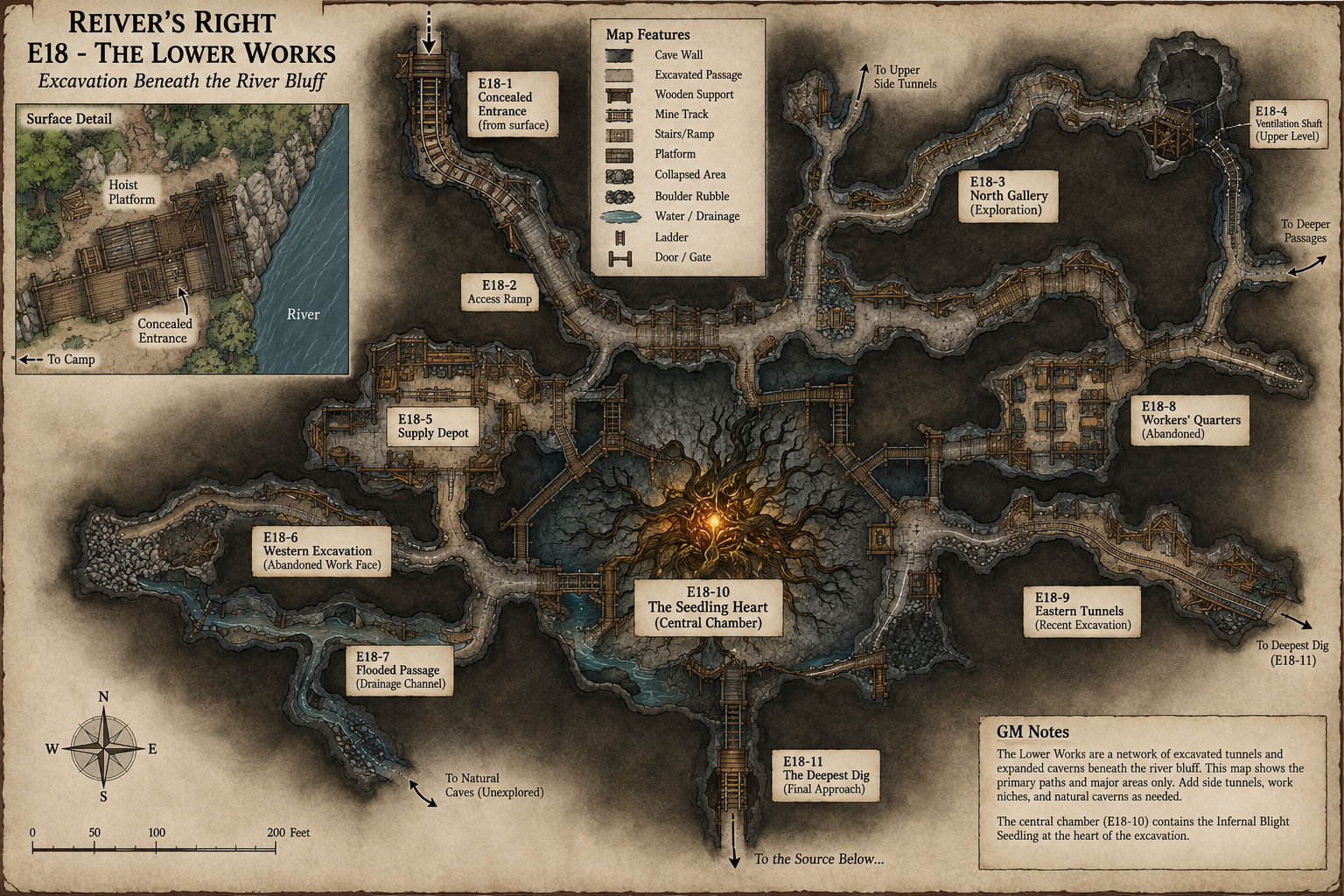
E18 — The Lower Works
The Lower Works
The Excavation Beneath the River Bluff
The trail ends against the river bluff.
At first there seems to be nothing here but stacked retaining timbers, coils of heavy rope, and an old hoisting frame built into the slope. The structure looks like part of Reiver's Right's logging operation: another place where cut timber might once have been dragged, lowered, or stored.
Then the details stop making sense.
The timbers are too thick. The iron fittings are too heavy. Deep grooves have been worn into the ground by wheels that were never meant to carry logs toward the river. Behind one wall of stacked lumber, a narrow draft carries the smell of damp stone, lamp smoke, and something metallic from somewhere inside the bluff.
The entrance to the Lower Works was deliberately constructed to resemble an ordinary part of Reiver's Right's logging infrastructure. From a distance, it appears to be nothing more than a reinforced storage bay and hoisting station built against the bluff.
In reality, the outer structure conceals a heavily reinforced passage descending into the rock beneath the camp. This is where Hendrick and the Golden Hand moved workers, equipment, structural timber, and excavation supplies into the underground operation without exposing what Reiver's Right was actually doing.
Challenge 1: Find the Concealed Entrance
Characters searching the river-bluff side of the camp can identify evidence that the apparent storage structure has been used for something other than ordinary logging.
The concealed entrance consists of a timber-faced section of retaining wall mounted on heavy iron pivots. A hidden release beneath the hoist platform disengages a locking bar, allowing the wall to swing inward.
The opening is large enough for a hauling cart and draft animal to pass through. Beyond it, a timber-braced ramp descends into darkness.
Hendrick and the Golden Hand did not rely only on secrecy. The entrance was also protected against unauthorized entry.
Challenge 2: The Hoist Release Trap
The concealed door is connected to the same counterweight system used by the exterior hoist. Opening it incorrectly releases one of the suspended weights above the entrance.
The false wall groans inward.
Cold air rolls out of the bluff carrying the smell of wet stone, old smoke, and stagnant water. Beyond the doorway, a broad timber-braced ramp slopes downward beneath a procession of soot-darkened beams. Iron rails have been fixed into the floor for heavy carts, their wheels leaving polished tracks through years of use.
The passage continues farther than any logging cellar should.
After several dozen yards, the tunnel opens suddenly into darkness.
Your light reaches the first row of supports, then the second, then loses itself somewhere beyond them.
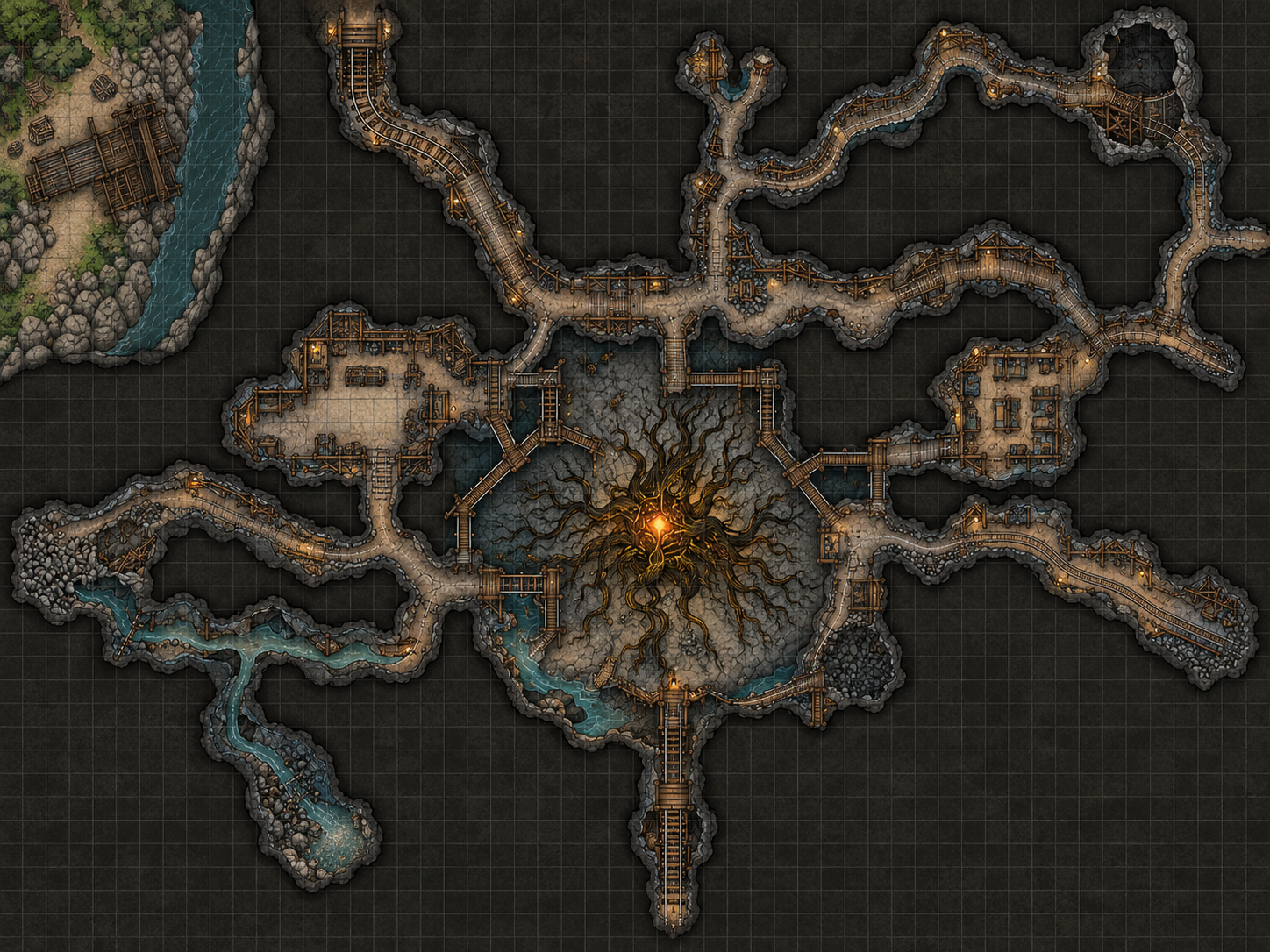
The bluff has been opened into a vast underground work site. Natural caverns have been widened with picks and wedges, their rough stone walls cut back into terraces, ramps, and galleries. Thick timber braces rise everywhere, supporting ceilings scarred by excavation. Empty ore carts and hauling sledges sit beside piles of broken stone. Chains hang from overhead pulleys. Narrow drainage trenches carry dark water toward channels cut into the cavern floor.
Canvas ventilation ducts sag between wooden frames. Rows of extinguished lamps line the main passages. Picks, sledgehammers, pry bars, drills, wedges, and replacement iron heads lie where workers abandoned them.
And everywhere, Reiver's Right's timber has followed the digging underground.
Whole trunks have been cut into support beams. Heavy cribbing holds back fractured walls. Platforms cling to stone faces high above the cavern floor. Rope bridges and ladders connect ledges that disappear into deeper darkness.
This was never a cellar beneath a logging camp.
It is an excavation.
The Lower Works should immediately feel much larger than the party expected. They are not a single tunnel or hidden room. The Golden Hand has spent years cutting into the bluff, following natural caverns where possible and forcing passages through solid stone where necessary.
The main excavation consists of a broad central cavern connected to several galleries, work faces, drainage passages, storage niches, abandoned side tunnels, and deeper shafts. Much of the construction is rough but professionally reinforced.
The operation could have supported dozens of workers at a time. It required exactly the equipment the party may already have traced through Reiver's Right's records: structural timber, heavy chain, pulleys, picks, wedges, lamp oil, ventilation canvas, drainage pipe, hauling carts, rope, and replacement iron tools.
Although the Lower Works resemble a mine, there are surprisingly few signs of systematic ore extraction. There are no large sorting floors, smelting facilities, or organized piles of valuable mineral.
Instead, excavation faces appear to have been chosen deliberately. Some passages were abandoned after only a few yards while others were driven aggressively through difficult stone. Survey marks cover certain walls, and several galleries change direction abruptly as though the workers were following measurements rather than mineral veins.
Characters with experience in mining can recognize the distinction: the Golden Hand was searching for something rather than simply extracting whatever the rock contained.
Challenge 3: Understand the Excavation
Characters examining the layout, discarded tools, survey markings, and working faces can determine what kind of operation the Lower Works supported.
The deeper portions of the Lower Works show increasingly obvious signs of infernal corruption. Black sap beads along roots exposed by excavation. Ember-red markings appear beneath strips of bark where living roots cross the cavern walls. In places, roots have forced themselves through cracks in stone that should be too narrow to support them.
Some support timbers have begun to change as well. The wood remains structurally sound, but dark veins run through the grain and patches of bark-like growth have formed over cut surfaces.
The corruption becomes more severe the farther the party travels from the concealed entrance and the closer they move toward the deepest excavation faces.
The Lower Works finally explain why so many workers disappeared without leaving through the South Gate. Signs of hurried abandonment are everywhere: overturned carts, dropped tools, extinguished lamps, abandoned packs, broken stretchers, and half-completed shoring.
Some workers may have fled deeper into the passages. Others may have been killed, transformed, trapped by collapses, or taken elsewhere. The Lower Works do not need to answer the fate of all fifty workers immediately, but they should make one fact unmistakable: a large portion of Reiver's Right's workforce was underground when the disaster occurred.
The Lower Works contain the first physical evidence too extensive to explain away as bookkeeping irregularities. Crates bear matching authorization marks. Equipment tags correspond to suppliers found in Hendrick's records. Several work stations use the same hand-and-coin symbol previously associated with the concealed financial network.
Hendrick's records, the suspicious purchases, and the physical excavation now fit together. Reiver's Right's logging operation was real, but it also supplied, staffed, and concealed this underground project.
Discovering the Lower Works should confirm the conspiracy without resolving its ultimate purpose. The party now knows that someone financed years of secret excavation beneath Reiver's Right and manipulated the site's agreements to make that digging possible.
What they should not learn yet is exactly what the Golden Hand hoped to find.
The deeper galleries should instead create a new question: what could possibly be buried beneath the Palakar that justified a decade of secrecy, false records, concealed labor, and forbidden excavation?
By the time the party enters the Lower Works, the investigation should stop being a theory. The Golden Hand was conducting a major clandestine excavation beneath Reiver's Right. Hendrick helped conceal it. Mining and excavation equipment were deliberately disguised among ordinary logging purchases, and a significant portion of the camp's workforce labored underground.
The party should also understand that the infernal blight becomes stronger around the excavation. Whether the digging released the corruption, disturbed something already present, or was deliberately attempting to reach it remains unresolved.