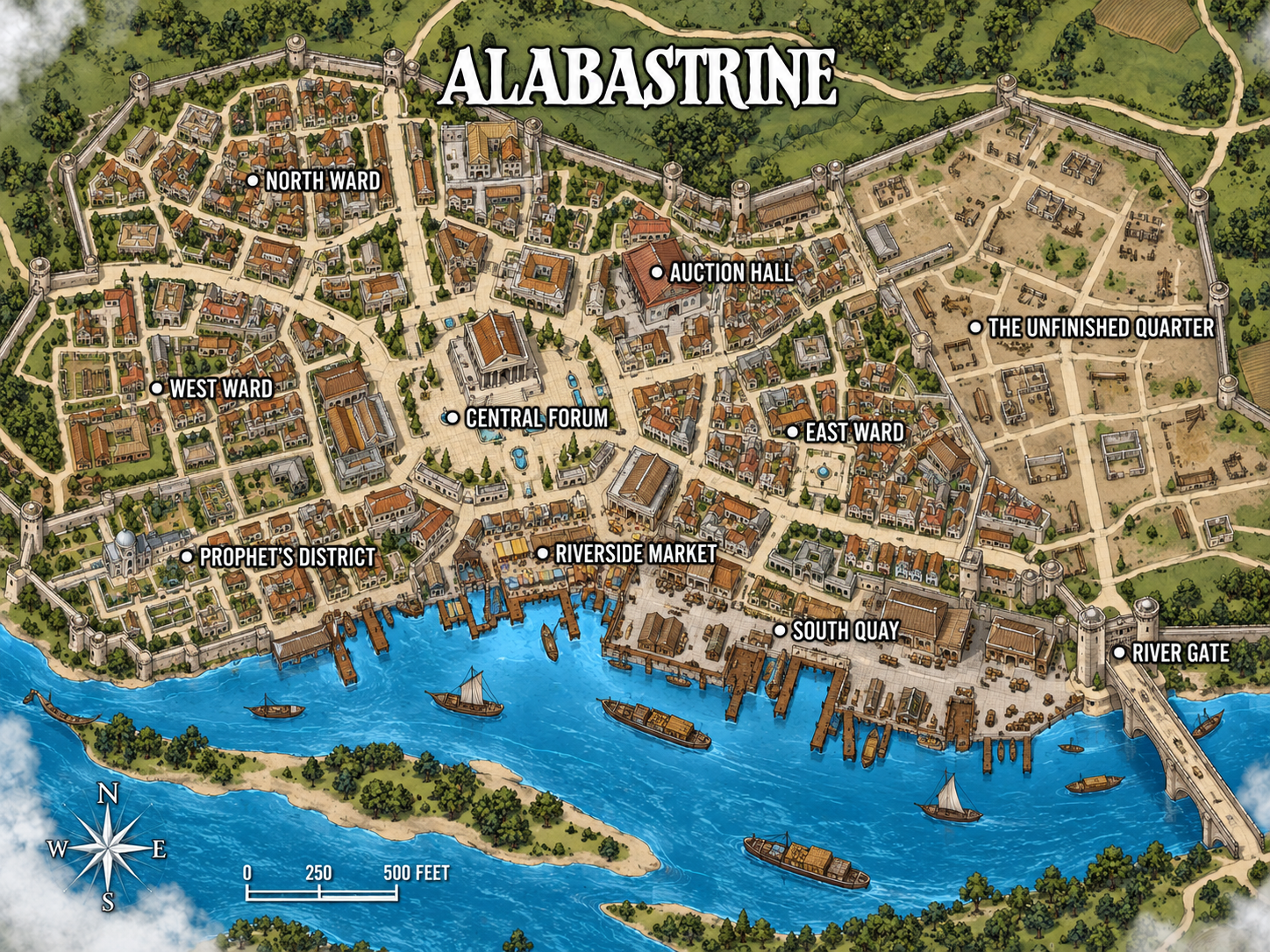
Alabastrine
Alabastrine is a city in Druma built in 4607 AR to accommodate Arodenite refugees after the deity's death. However, the migration never happened in the numbers its investors expected, and its hasty construction ceased before it was completed. High Prophet Kelldor purchased the partially finished city in 4711 AR, and since then the Druman government has auctioned control of the city's districts in five-year spans to the highest bidders. The most recent auction on record occurred in 4716 AR.
Alabastrine Location Directory
A Traveler's Guide to Druma's Unfinished City
Civic & Administrative Landmarks
Landmark
Overview & Primary Function
Central Forum
The city's principal public square, originally designed as the centerpiece of an ambitious new settlement. Broad paved avenues converge around formal gardens, fountains, and substantial civic buildings. The forum remains a gathering place for residents and visitors.
Auction Hall
A municipal building associated with the periodic auction of administrative control over Alabastrine's districts. The surrounding offices accommodate registrars, commercial representatives, and the paperwork required to administer competing district leases.
River Gate
A fortified passage connecting the eastern riverfront to the main bridge across the water. Gatekeepers supervise the movement of carts, travelers, and commercial freight entering or leaving the city by this crossing.
Residential & Historical Districts
District
Overview & Character
North Ward
One of Alabastrine's more established residential quarters, with orderly streets, enclosed gardens, and substantial stone buildings. Its comparatively complete construction contrasts with the city's abandoned expansion areas.
West Ward
A mixed residential and artisan district characterized by modest townhouses, workshops, small courtyards, and local businesses. The neighborhood accommodates residents whose livelihoods depend on the city's everyday commercial activity.
East Ward
A densely occupied neighborhood between the central civic district and the unfinished eastern expansion. Buildings range from simple residences to more substantial commercial properties, with narrow streets and small public courtyards.
Prophet's District
A district whose name recalls the city's original purpose as a refuge for followers of Aroden after his death. Its planned religious buildings, pale stone architecture, and formal courtyards reflect the expectations of its founders, although the anticipated population never fully arrived.
The Unfinished Quarter
An extensive eastern district where construction stopped before the original plans could be completed. Empty building plots, exposed foundations, partially assembled structures, and broad unused streets preserve the outline of a neighborhood that never fully developed.
Commercial & Waterfront Districts
Location
Overview & Primary Services
Riverside Market
A busy trading area adjoining the central waterfront. Merchants operate stalls and permanent shops selling provisions, household goods, imported merchandise, and locally produced wares. The nearby landing stages accommodate riverboats delivering passengers and cargo.
South Quay
The city's principal freight-handling waterfront, with warehouses, stone quays, timber piers, and loading equipment. River barges and commercial vessels exchange goods here, supporting employment for dockworkers, warehouse staff, and freight carriers.