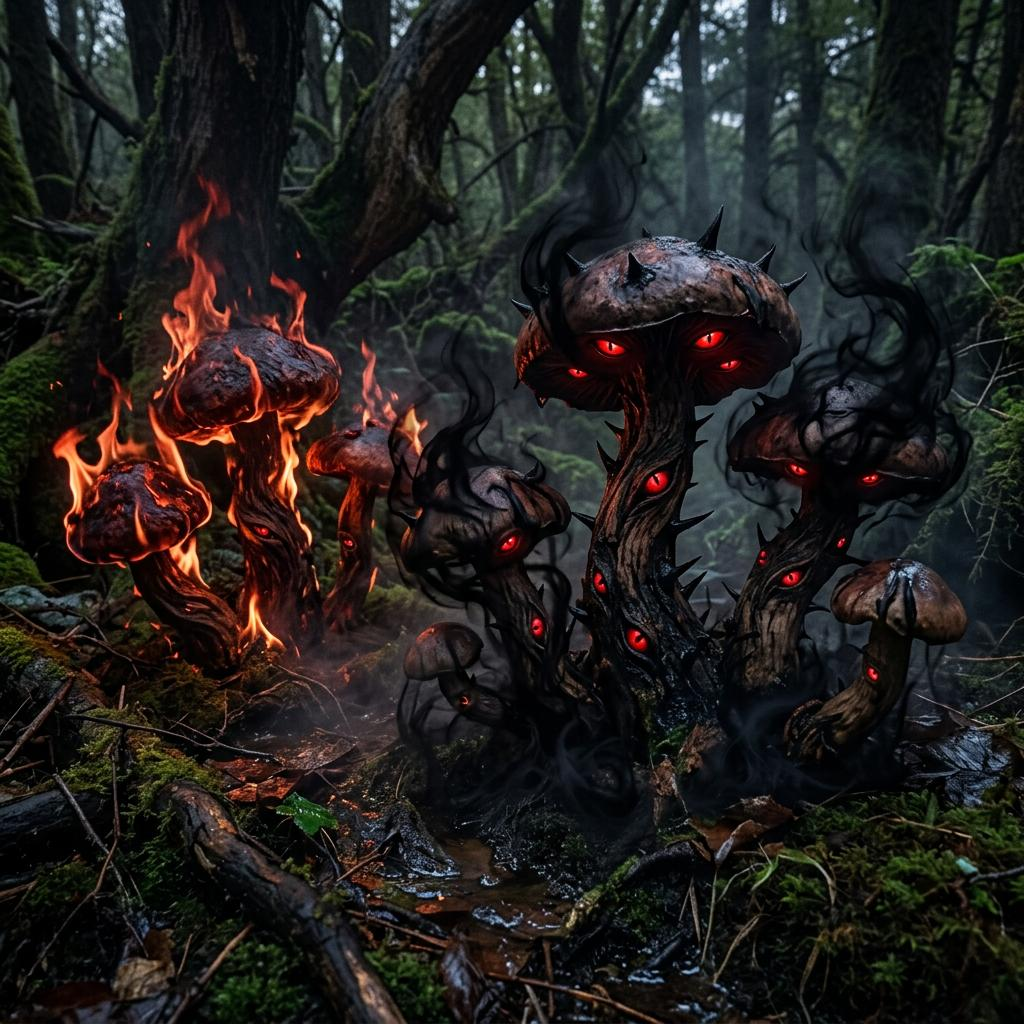
Infernal Blightseed Swarm
Creature 0Source: Custom Creature
Infernal Blightseed Swarm
Creature 0
Uncommon · Large · Fiend · Plant · Swarm
An infernal blightseed swarm consists of hundreds of tiny, partially awakened seedlings moving together as a writhing carpet of blackened roots, hooked thorns, and ember-red growths. Each individual seedling is scarcely larger than a human hand, with twisted rootlets serving as legs and needlelike thorns protruding from its scorched bark.
Unlike the larger infernal rootlings, these seedlings have not developed independent bodies or fully formed predatory instincts. Instead, they move collectively, responding to vibrations, living tissue, and the influence of nearby blight growths. Their motion resembles a flood of skittering insects, except that every individual is a piece of living, infernally corrupted vegetation.
When the swarm attacks, hundreds of seedlings crawl over their victims, driving tiny thorns into exposed flesh. Some attempt to embed their roots beneath the skin, introducing the same lignifying corruption found in more developed blight creatures. Individually, the seedlings are almost harmless. Together, they can overwhelm creatures many times their size.
Perception +6; darkvision, tremorsense (imprecise) 10 feet
Languages understands Infernal but can't speak
Skills Acrobatics +6, Stealth +7 (+9 among roots, debris, or heavy vegetation)
Str –3, Dex +3, Con +2, Int –5, Wis +1, Cha –4
AC 16
Fort +6, Ref +9, Will +3
HP 20
Immunities grapple, precision, prone, restrained, swarm mind
Resistances bludgeoning 3, piercing 5, slashing 3
Weaknesses area damage 3, splash damage 3, vitality 2
Speed 20 feet, climb 10 feet
Swarm The blightseed swarm occupies a 10-foot-by-10-foot space. It can occupy the same space as other creatures and move through spaces occupied by enemies. It cannot make ordinary melee Strikes and instead attacks creatures sharing its space using Swarming Thorns.
Swarming Thorns ◆
Hundreds of hooked seedlings surge across exposed flesh, driving tiny wooden barbs into their victims while attempting to force their roots beneath the skin.
Each enemy in the swarm's space must attempt a DC 16 basic Reflex save against 1d4+2 piercing damage.
A creature that fails its Reflex save is also exposed to Creeping Lignification.
A creature can be exposed to Creeping Lignification from Swarming Thorns only once per round, regardless of how many times the swarm uses this ability.
Creeping Lignification
curse, primal
Tiny infernal seedlings embed their rootlets into living flesh. Black veins spread outward from the punctures while thin woody fibers briefly form beneath the victim's skin, causing muscles and joints to stiffen.
The affected creature must attempt a DC 16 Fortitude save.
Critical Success The creature is unaffected.
Success The creature is unaffected.
Failure The creature takes a –5-foot status penalty to its Speeds until the end of its next turn.
Critical Failure The creature takes a –5-foot status penalty to its Speeds and becomes clumsy 1 until the end of its next turn.
The effect does not stack with other Infernal Lignification effects. Apply only the more severe effect.
At this immature stage, the corruption cannot establish permanent roots within a living host. The woody fibers become brittle and crumble when the supernatural effect ends.
Root-Slip ◆
move
The swarm separates into hundreds of tiny growths and pours through gaps in the surrounding terrain.
The swarm Strides up to half its Speed. During this movement, it ignores difficult terrain caused by roots, fallen timber, wooden debris, and vegetation.
The swarm can flow beneath loose boards, around tightly packed logs, and through small openings that individual seedlings could physically pass through, provided the openings connect to a space large enough for the swarm to occupy.
Root-Slip does not allow the swarm to pass through solid walls, sealed doors, or completely blocked passages.
Ember Bloom ◆◆
fire, primal
Frequency once per encounter
The seedlings abruptly stop moving and plunge their rootlets into the ground. Ember-red light spreads through the entire mass before hundreds of tiny infernal blossoms open simultaneously, releasing a burst of scorching heat.
Each creature sharing the swarm's space must attempt a DC 16 basic Reflex save against 1d4 fire damage.
After using Ember Bloom, the swarm becomes temporarily stationary. It cannot use move actions until the beginning of its next turn as its roots withdraw from the ground.
The blossoms collapse immediately after releasing their heat, leaving behind small curls of black smoke and the sharp smell of scorched cedar.
Swarm Mind
The swarm possesses no individual consciousness. Its movements arise from a rudimentary collective instinct shared between hundreds of infernal seedlings.
It is immune to effects that target the mind of an individual creature, including mental effects.
The swarm does not understand tactics, commands, or social interaction. However, it responds to the presence of living creatures, nearby blight growths, and supernatural signals transmitted through corrupted root systems.
Tactics
Infernal blightseed swarms prefer confined spaces, dense undergrowth, rotting timber, and subterranean passages where their small constituent seedlings can remain concealed. They frequently gather beneath collapsed wooden structures, inside hollow logs, and around the exposed roots of contaminated trees.
A swarm normally approaches unnoticed, flowing through cracks or beneath debris until it can engulf one or more creatures.
Once it reaches its victims, the swarm repeatedly uses Swarming Thorns, attempting to spread Creeping Lignification while remaining in contact with its prey.
When several enemies occupy its space, the swarm may use Ember Bloom to damage multiple targets. Because this ability leaves the swarm stationary, it is generally used only when the seedlings have already surrounded their victims.
The swarm uses Root-Slip to navigate fallen timber, tight excavation passages, and dense root systems. It does not deliberately pursue enemies through large open areas unless responding to the influence of a nearby blight source.
Like other manifestations of the infernal blight, these seedlings display particular hostility toward fey, animals, and creatures using primal magic.
Ecology
Infernal blightseed swarms represent one of the earliest mobile stages of the corruption spreading through the Palakar Forest.
They form when an established concentration of infernal blight releases hundreds of small, animated growths into the surrounding soil. These growths initially resemble malformed seeds or root nodules, but quickly develop hooked appendages capable of locomotion.
At this stage, the seedlings are too small and weak to survive independently for long periods. Instead, they gather into swarms, sharing a collective response to threats and moving together toward favorable growing conditions.
The seedlings feed upon decaying vegetation, mineral-rich soil, black sap, and residual infernal energy. They are particularly attracted to contaminated wood and established blight growths.
Given sufficient nourishment and time, surviving seedlings may develop into larger, individually mobile Infernal Rootlings. The swarm gradually disperses as individual specimens become capable of independent movement.
Larger blight creatures can also attract swarms. Infernal thornlings and mature blight growths sometimes move through areas surrounded by numerous small seedlings that follow them like living underbrush.
Signs of the Blight
A destroyed blightseed swarm leaves behind a scattered carpet of tiny scorched seedlings, broken thorns, and rapidly drying black sap.
Close examination reveals that each seedling contains a surprisingly complex internal network of roots and hollow channels, suggesting that the organisms were growing toward a more developed physical form.
Embedded within the roots are microscopic flecks of gold-colored mineral growth. These deposits match the metallic inclusions found in infernal rootlings, thornlings, and mature blight creatures.
The amount of mineral growth is extremely small. Comparing specimens suggests that the gold-colored material accumulates as the corruption matures.
Even after destruction, some seedlings remain partially active for several minutes. Their broken roots twitch and slowly turn toward the nearest concentration of active infernal blight.
GM Notes
Role Low-level swarm, area denial, and battlefield nuisance.
Encounter Use Infernal blightseed swarms are designed for encounters involving several weak enemies or for supporting a larger blight creature.
Their physical resistances make ordinary weapon attacks less effective, while area damage, splash damage, and vitality damage provide effective counterplay.
Swarming Thorns creates steady pressure without the high burst damage of stronger blight creatures. Creeping Lignification encourages the party to move away from the swarm rather than standing in place and exchanging attacks.
Recommended Encounters Two or three swarms can occupy a contaminated passage, lumber storage area, or abandoned excavation. Additional swarms may accompany an Infernal Rootling or Infernal Thornling to complicate battlefield movement.
Reiver's Right — Lower Works Blightseed swarms are particularly appropriate beneath the logging camp, where black sap has collected around excavation supports, drainage channels, and discarded timber.
They can emerge from cracks beneath loose planking, gather around contaminated shoring, or flow out of collapsed storage spaces without requiring additional tunnels or exits from the encounter map.
Investigation Nature or Crafting DC 16 identifies the seedlings as immature manifestations of the larger infernal blight. A critical success reveals that the individual seedlings are developing structures resembling the limbs and internal tissues of Infernal Rootlings.
Development The infernal blight's early mobile progression is: Blightseed Swarm → Infernal Rootling → Infernal Thornling . More mature growths eventually develop into specialized forms such as Infernal Treelings and Infernal Blight Stalkers.