Blightroot
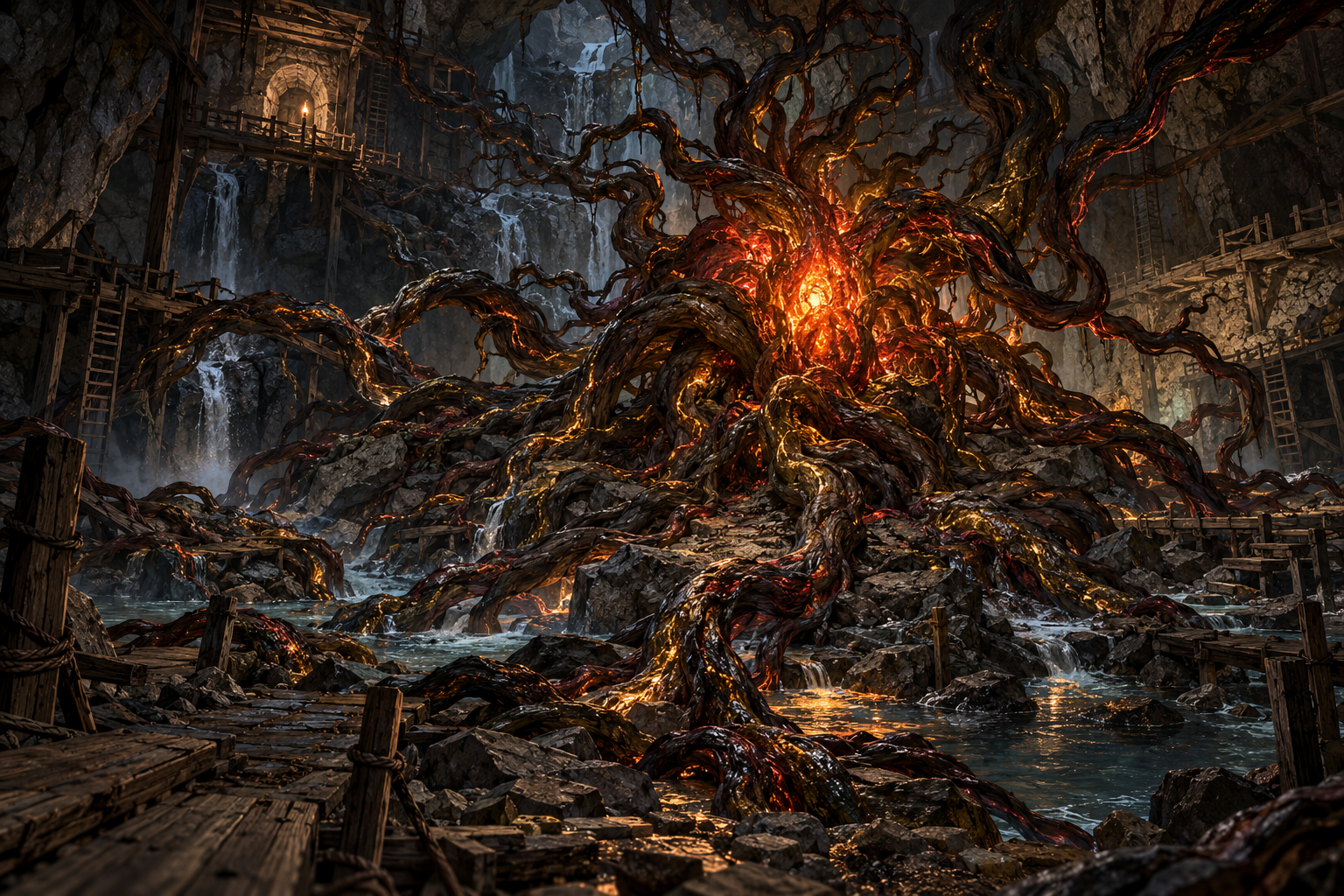
BLIGHTROOT CREATURE 2
[UNCOMMON] [LARGE] [FIEND] [PLANT]
A blightroot is the second established stage of an infernal blight infestation. What began as a heart-sized Blight Seedling has anchored itself into surrounding soil, stone fractures, groundwater, and living root systems, becoming a sprawling stationary organism.
Thick blackened roots radiate from a dense central knot of woody tissue. Cracks within the growth pulse with dull ember-red light, while channels of viscous black sap run through its interior. Mature feeder roots can move independently, lashing at nearby creatures or erupting through loose earth and fractured stone.
Despite the similar name, a Blightroot is not an Infernal Rootling. Rootlings are mobile creatures associated with the corruption. A blightroot is the rooted infestation itself.
Perception +8; darkvision, tremorsense (imprecise) 30 feet
Languages understands Infernal but can't speak
Skills Athletics +10, Survival +8
Str +4, Dex –1, Con +4, Int –4, Wis +2, Cha –1
AC 17
Fort +10, Ref +5, Will +8
HP 50
Resistances fire 3
Weaknesses vitality 5
Rooted Mass The blightroot is physically integrated into the surrounding terrain. It can't be forcibly moved and can't be knocked prone.
Distributed Organism The visible central knot is only the densest portion of the creature. Cutting minor tendrils or destroying isolated roots doesn't damage the blightroot unless the attack affects its occupied space or a major exposed root that the GM treats as part of the creature.
Speed 0 feet
Melee ◆ root lash +10 (reach 15 feet), Damage 1d10+4 bludgeoning
Ranged ◆ caustic sap +8 (range increment 30 feet), Damage 1d6+4 acid
SPECIAL ABILITIES
Grasping Root Eruption ◆◆ [primal]
Frequency once per round
The blightroot drives a violent pulse through its underground network. Roots burst from cracks, loose soil, and broken stone in a 15-foot emanation. Each creature in the area must attempt a DC 18 Reflex save.
Critical Success The creature is unaffected.
Success The creature avoids the erupting roots. Its space becomes difficult terrain until the beginning of the blightroot's next turn.
Failure The creature takes 1d6 bludgeoning damage and is immobilized by grasping roots. It can Escape against DC 18.
Critical Failure As failure, but the creature takes 2d6 bludgeoning damage.
Black Sap Spray ↻ [acid]
Trigger A creature within 10 feet deals slashing or piercing damage to the blightroot.
Effect The wound ejects a pressurized spray of thick, smoking black sap. The triggering creature attempts a DC 18 Reflex save.
Critical Success Unaffected.
Success 1 acid damage.
Failure 1d6 acid damage.
Critical Failure 1d6+2 acid damage and the creature is off-guard until the start of its next turn as sticky sap clings to its limbs and equipment.
Hellroot Surge ◆ [fire] [primal]
The blightroot channels infernal heat through its exposed roots. Until the beginning of its next turn, its root lash Strikes deal an additional 1d4 fire damage.
RECALL KNOWLEDGE & INVESTIGATION
These checks should normally be made by the character performing the relevant investigation. Different characters can examine different aspects of the organism.
Recall Knowledge — Nature or Religion DC 18
Success The character recognizes the blightroot as an established stationary infestation rather than an ordinary plant creature. Reveal one useful fact, such as its vitality weakness, resistance to fire, immobility, or ability to attack through surrounding roots.
Critical Success Reveal two useful facts. The character also recognizes that the infernal traits appear to have been grafted onto a living primal growth rather than belonging to a naturally occurring fiend.
Failure The character recalls no reliable information.
Critical Failure The character mistakes the mass for an ordinary supernatural plant growth or assumes that burning it is the safest way to destroy it.
Trace the Root Growth — Nature or Survival DC 16
Success establishes that the root system radiates outward from the dense central mass rather than converging naturally upon it.
On a critical success, the character can distinguish older central tissue from younger outward growth and concludes that the infestation began at a single point in this chamber.
Study the Black Sap — Crafting or Nature DC 17
Success confirms that the sap contains altered living plant material mixed with an unnatural mineral component.
On a critical success, the character finds tiny gold-colored crystalline deposits distributed through the tissue, similar to those present in other infernal blight specimens.
Examine the Excavation — Crafting or appropriate Lore DC 16
Success shows that the miners excavated and reinforced this chamber before the root mass spread through it.
On a critical success, the character identifies several places where roots followed drainage cuts, exposed fractures, and work channels created during excavation. The mining operation unintentionally gave the organism easier paths through the rock.
Collect a Central Tissue Sample — Crafting, Medicine, or Nature DC 16
Success produces an intact sample containing living blight tissue, black sap, altered woody fibers, and mineral deposits suitable for detailed alchemical study.
A sample taken from the central mass is substantially more useful to Morwenna than surface-corrupted timber.
TACTICS
The blightroot is completely stationary. It senses creatures through vibration in the floor, exposed roots, and surrounding stone rather than pursuing them.
When several creatures enter the chamber, it uses Grasping Root Eruption to restrict movement, then lashes at immobilized or isolated targets with its long roots.
Creatures that remain outside its reach are targeted with caustic sap. Once enemies close with the central mass, Black Sap Spray makes repeated cutting attacks increasingly hazardous.
The blightroot does not retreat and has little recognizable instinct for self-preservation. It continues defending the infestation until destroyed, neutralized, or severed from whatever infernal influence sustains it.
BIOLOGY & DEVELOPMENT
A blightroot begins as a planted Blight Seedling. Once established, the seedling sends feeder roots into nearby soil, existing vegetation, groundwater, and fractures in stone.
Eventually the original heart-sized organism can no longer be cleanly separated from its surroundings. Its central tissue thickens while secondary roots spread outward, transforming the organism into a distributed underground mass.
If allowed to continue developing, a blightroot can eventually become a Blight Node, capable of sustaining corruption across a much larger area.
GM NOTES
Biological Stage: Stage 2 — Blightroot.
Role: Stationary brute / battlefield controller.
Creature Level: 2.
Adventure Function: The E18-10 blightroot demonstrates what happens when one of the planted Blight Seedlings is allowed to establish itself. This should be the party's first clear evidence that the infection is not simply spreading from contaminated timber. Something was placed here and grew outward.
Naming: A Blightroot is part of the stationary infestation progression: Blight Seedling → Blightroot → Blight Node → Blight Heart.
It is distinct from the mobile blight creatures: Infernal Rootlings, Infernal Thornlings, Infernal Treelings, Infernal Blight Stalkers, and Infernal Blight Revelers.
E18-10 Clue: The oldest roots cluster tightly around one point near the center of the chamber. Excavation cuts and drainage channels predate the growth. The physical evidence therefore supports the conclusion that the Lower Works were excavated first and the blight was introduced afterward.