E1 — South Gate (North Road)
Background art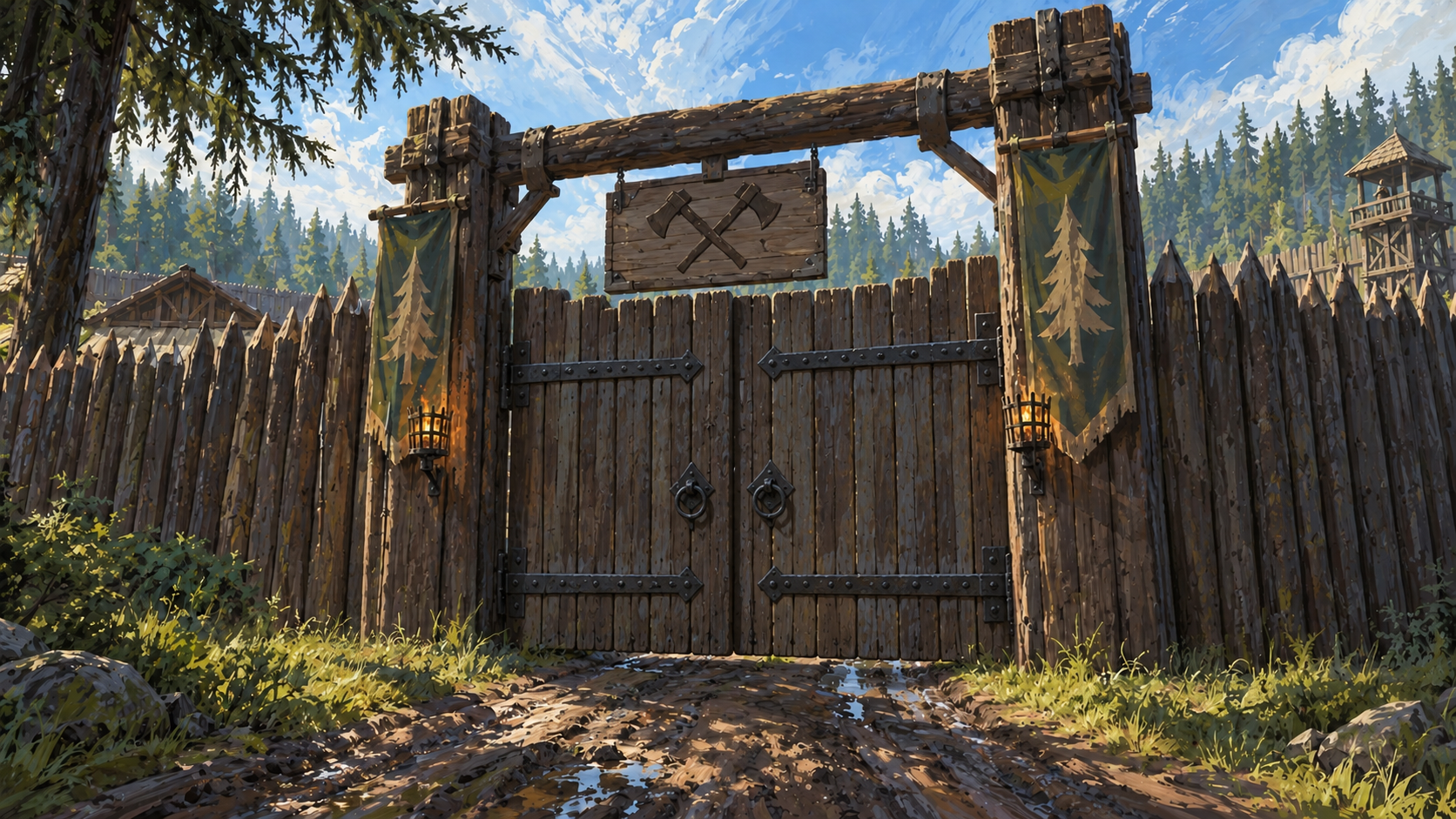
South Gate
The North Road Entrance
The North Road ends abruptly at a tall timber palisade thrown across the shoulder of the river bluff. Sharpened logs rise in an uneven line above the road, weather-darkened and bound together with heavy crossbeams. At their center stands the south gate: two massive timber doors reinforced with broad iron straps, pulled fully shut beneath a rough wooden sign bearing the crossed axes of Reiver's Right.
Deep wagon ruts churn the road before the gate into dark mud. Boot prints, wheel tracks, and the impressions of heavy draft animals overlap near the entrance, remnants of the traffic that once passed regularly through here. Faded logging banners hang from the gateposts, their cloth lifting and settling in the breeze. Above the palisade, the roof of a watchtower rises among the surrounding trees, but its platform appears empty.
The forest presses close around the abandoned road. Wind moves through the Palakar canopy and brushes the sharpened tops of the palisade, but from the other side comes nothing: no shouted orders, no ringing tools, no creak of machinery, not even the ordinary murmur of a working camp.
No guard challenges you. No bell rings.
Reiver's Right is sealed shut, and whatever waits inside gives no sign that it knows you are here.
The gate and surrounding palisade are intact. There are no obvious signs of a siege, forced entry, fire, or organized evacuation. Reiver's Right looks less like a settlement that was abandoned and more like a working camp whose routine simply stopped.
Challenge 1: Read the Approach
The road outside the gate preserves several days of wagon, animal, and foot traffic. Most of it is badly overlapped, but careful examination can reconstruct the final movements through the south entrance.
Characters who already learned that commercial traffic from Reiver's Right stopped approximately four days ago do not need a check to recognize that the newest heavy wagon tracks fit that timeline. The challenge above determines what additional information they can recover from the road.
Challenge 2: Inspect the Gate
The gate itself provides another clue. Its iron straps, hinges, locking hardware, and surrounding timbers show no obvious battle damage. Characters who examine it closely can determine whether someone forced their way into or out of the camp.
The closed gate is an obstacle, not a required skill check. Allow any reasonable method of entry. Characters might climb the palisade, force the doors, manipulate the interior bar through a gap, reach the gatehouse, or find another route around the enclosure.
Climbing the Palisade: Athletics DC 15. The sharpened upper timbers make careless climbing dangerous, but failure should cost time or position rather than block entry entirely.
Forcing the Gate: Athletics DC 18. Success opens the gate violently and produces considerable noise. This may justify advancing a random event or alerting anything still active within the camp.
Careful Entry: Thievery DC 16 or another plausible method can manipulate the gate's securing mechanism without damaging it. Particularly clever plans may succeed automatically at the GM's discretion.
Once inside, characters can open the gate normally from the camp side. Do not make entry into Reiver's Right depend on a single successful roll.
The South Gate should leave the party with three useful conclusions: Reiver's Right was operating normally until very recently, its workforce did not evacuate through the main road, and the camp was not obviously overrun from outside.
Do not explain the disappearance here. Location 1 establishes the mystery; later locations should progressively reveal what happened inside the palisade.