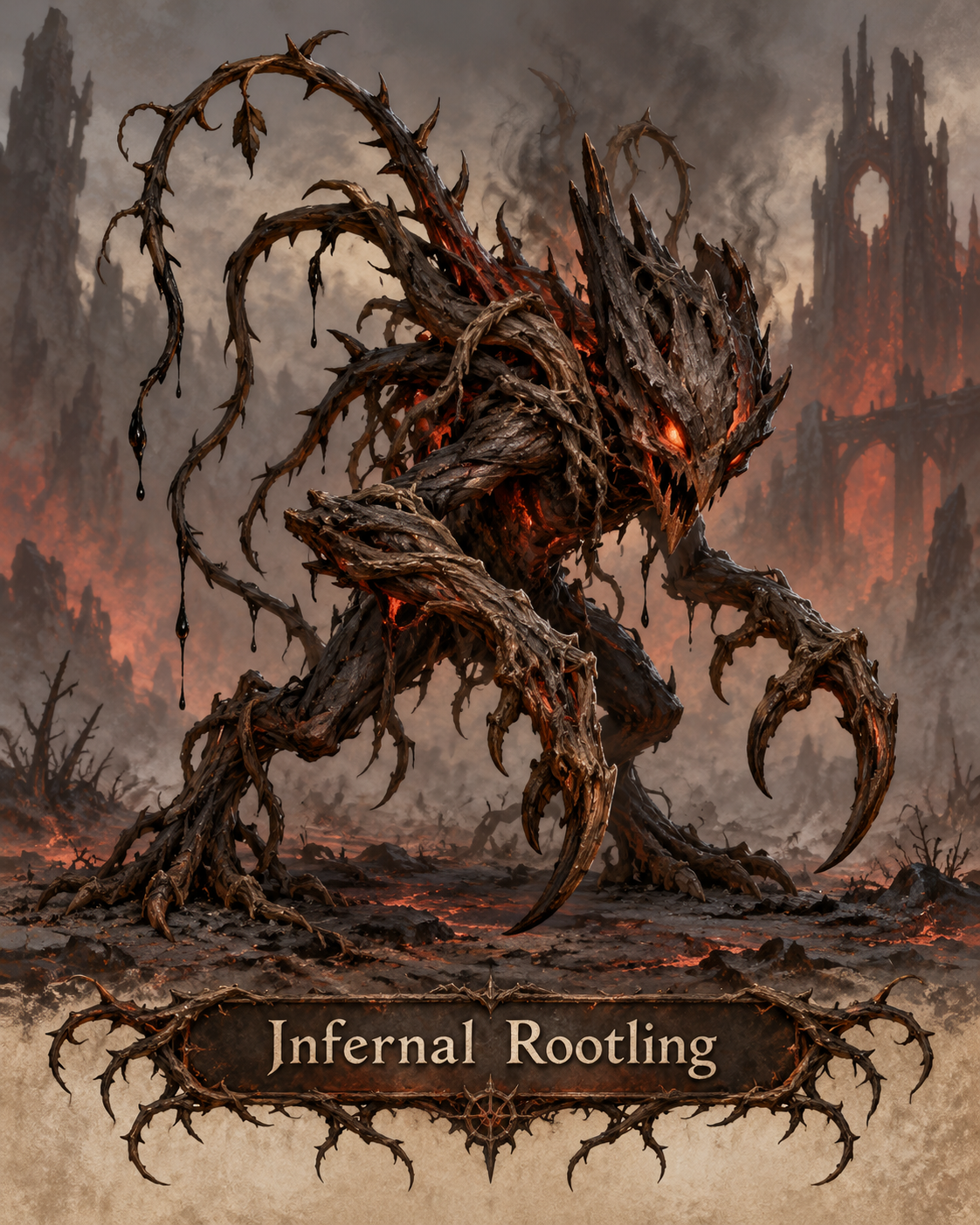
Infernal Rootling
Creature 0Source: Custom Creature
Infernal Rootling
Creature 0
Uncommon · Small · Fiend · Plant
Infernal rootlings are newly awakened growths of the corruption spreading beneath the Palakar Forest. They resemble tangles of blackened roots pulled roughly into the shape of an animal or hunched humanoid, supported by hooked wooden limbs and trailing thorn-covered tendrils.
Their bark is thin enough that dull ember-red light can sometimes be seen beneath it. When injured, they bleed thick black sap that smokes when exposed to the air. Rootlings represent one of the earliest mobile stages of the infernal blight: dangerous, aggressive, and capable of spreading minor manifestations of the same lignifying corruption found in more developed blight creatures.
Perception +6; darkvision
Languages understands Fey and Infernal but can't speak
Skills Athletics +6, Stealth +5 (+7 in forests or heavy vegetation), Survival +5
Str +3, Dex +2, Con +2, Int –2, Wis +2, Cha +0
AC 16
Fort +8, Ref +6, Will +6
HP 18
Resistances fire 1
Weaknesses vitality 2
Speed 25 feet, climb 10 feet
Melee ◆ claw +8, Damage 1d4+2 slashing plus infernal lignification
Melee ◆ tendril +8 (reach 10 feet), Damage 1d4+1 bludgeoning
Infernal Lignification
curse, primal
When the rootling damages a living creature with its claw, thin black veins spread outward from the wound and the victim's muscles briefly harden like green wood. The target must attempt a DC 16 Fortitude save.
Critical Success The creature is unaffected.
Success The creature is unaffected.
Failure The creature takes a –5-foot status penalty to its Speeds until the end of its next turn.
Critical Failure The creature takes a –5-foot status penalty to its Speeds and is clumsy 1 until the end of its next turn.
The effect is temporary at this stage of the creature's development. Thin woody fibers form beneath the victim's skin but crumble once the blight magic sustaining them fades.
Hellroot Eruption ◆◆
fire, primal
Frequency once per 1d4 rounds
The rootling drives its tendrils into the ground. Burning black roots tear through the soil in a 5-foot burst within 20 feet.
Each creature in the area must attempt a DC 16 Reflex save.
Critical Success The creature is unaffected.
Success The creature takes half damage.
Failure The creature takes 1d4 piercing damage plus 1d4 fire damage.
Critical Failure The creature takes double damage and falls prone.
The affected squares become difficult terrain until the start of the rootling's next turn as smoking roots remain twisted above the surface.
Black Sap Reprisal ↻
fire
Trigger A creature within 5 feet deals slashing or piercing damage to the rootling.
Effect A pressurized blister beneath the rootling's bark ruptures, spraying hot black sap toward the attacker. The triggering creature must attempt a DC 15 Reflex save.
Critical Success The creature is unaffected.
Success The creature is unaffected.
Failure The creature takes 1 fire damage.
Critical Failure The creature takes 1d4 fire damage and is dazzled until the end of its next turn as smoking sap spatters across its face.
Tactics
Infernal rootlings instinctively remain near trees, exposed roots, dense brush, or other terrain that provides cover. They rarely charge directly across open ground unless driven forward by a stronger blight creature.
A rootling uses Hellroot Eruption when multiple creatures cluster together, especially around narrow passages or difficult terrain. It then lashes at enemies from reach with its tendril or closes with injured targets to spread Infernal Lignification.
Rootlings display a particular hostility toward fey, animals, and creatures using primal magic. Unlike more developed blight creatures, however, their behavior is largely instinctive. A lone rootling can retreat from an obviously superior threat, usually scrambling into undergrowth or climbing into tangled roots.
Ecology
Rootlings form where concentrations of infernal blight have begun colonizing living root systems. Most begin as nearly immobile knots of corrupted vegetation. As black sap circulates through the growth and infernal energy accumulates within it, several roots detach from the surrounding soil and reorganize into crude limbs.
This transition marks the first stage at which the blight can actively defend itself and move beyond the immediate area in which it germinated.
Rootlings are not independent organisms in the normal sense. Their instincts remain closely tied to the larger blight and to stronger creatures growing from it. They frequently gather near corrupted trees, underground growths, infernal seedlings, and other concentrations of black sap.
Signs of the Blight
A slain rootling collapses into a loose mass of scorched roots and cracked bark. Cutting through the remains reveals thick black sap running through channels where normal plant tissue should be.
Close examination also reveals tiny flecks of gold-colored mineral growth embedded among the creature's roots. The deposits are much smaller than those found in mature infernal blightlings, suggesting that the material accumulates as the creature develops.
GM Notes
Role Lesser skirmisher and battlefield nuisance.
Encounter Use Infernal rootlings are intended primarily as groups of lesser enemies or as support creatures accompanying a more dangerous blight creature.
Their reach allows them to threaten space without dealing large amounts of damage, while Hellroot Eruption briefly changes the battlefield and encourages the party to keep moving.
Development Infernal rootlings are an early mobile stage of the same corruption that eventually produces stronger creatures such as Infernal Thornlings and Infernal Blightlings.