Reiver's Right — Location 7
Storehouse
Logging Supplies and the Wrong Kind of Equipment
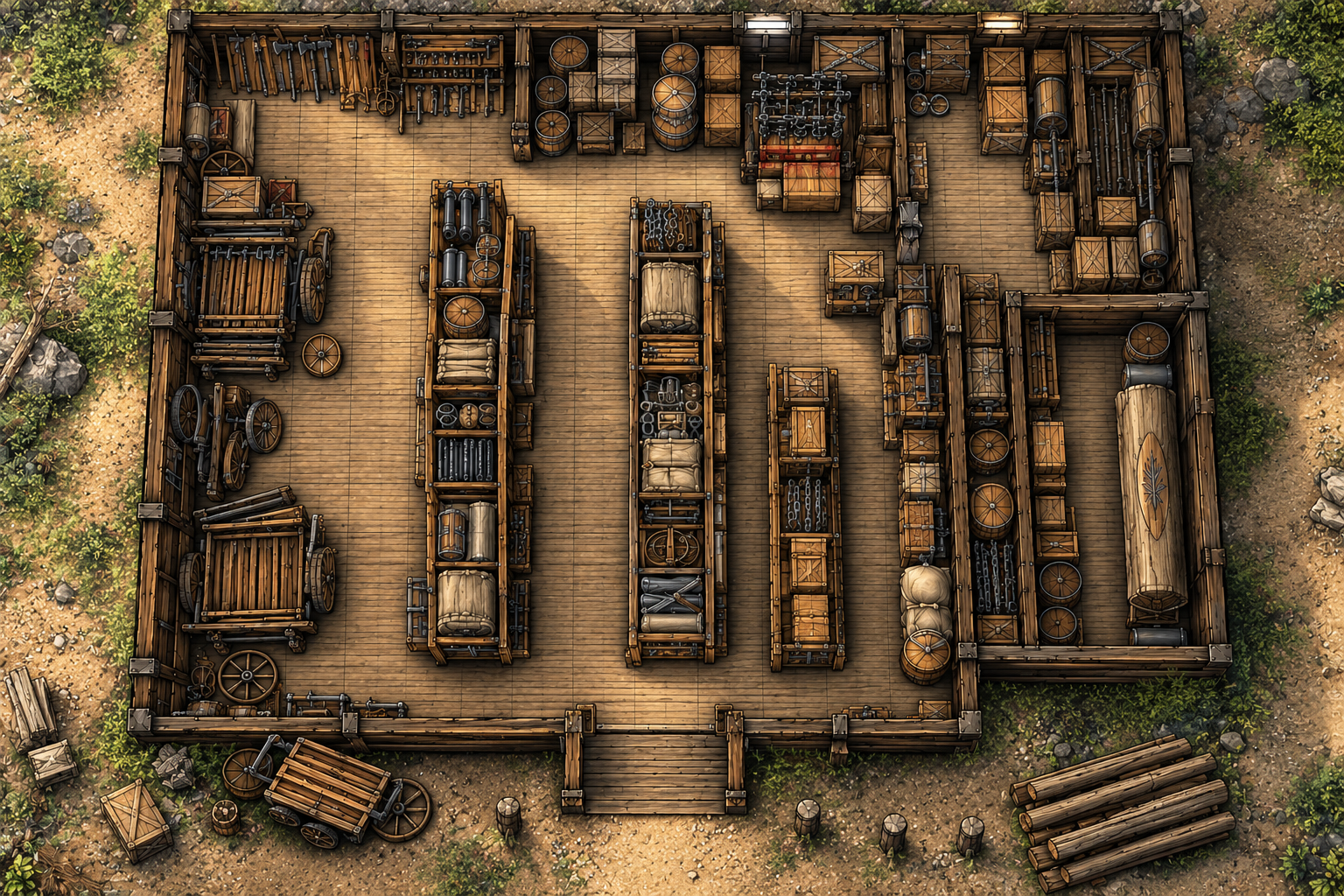
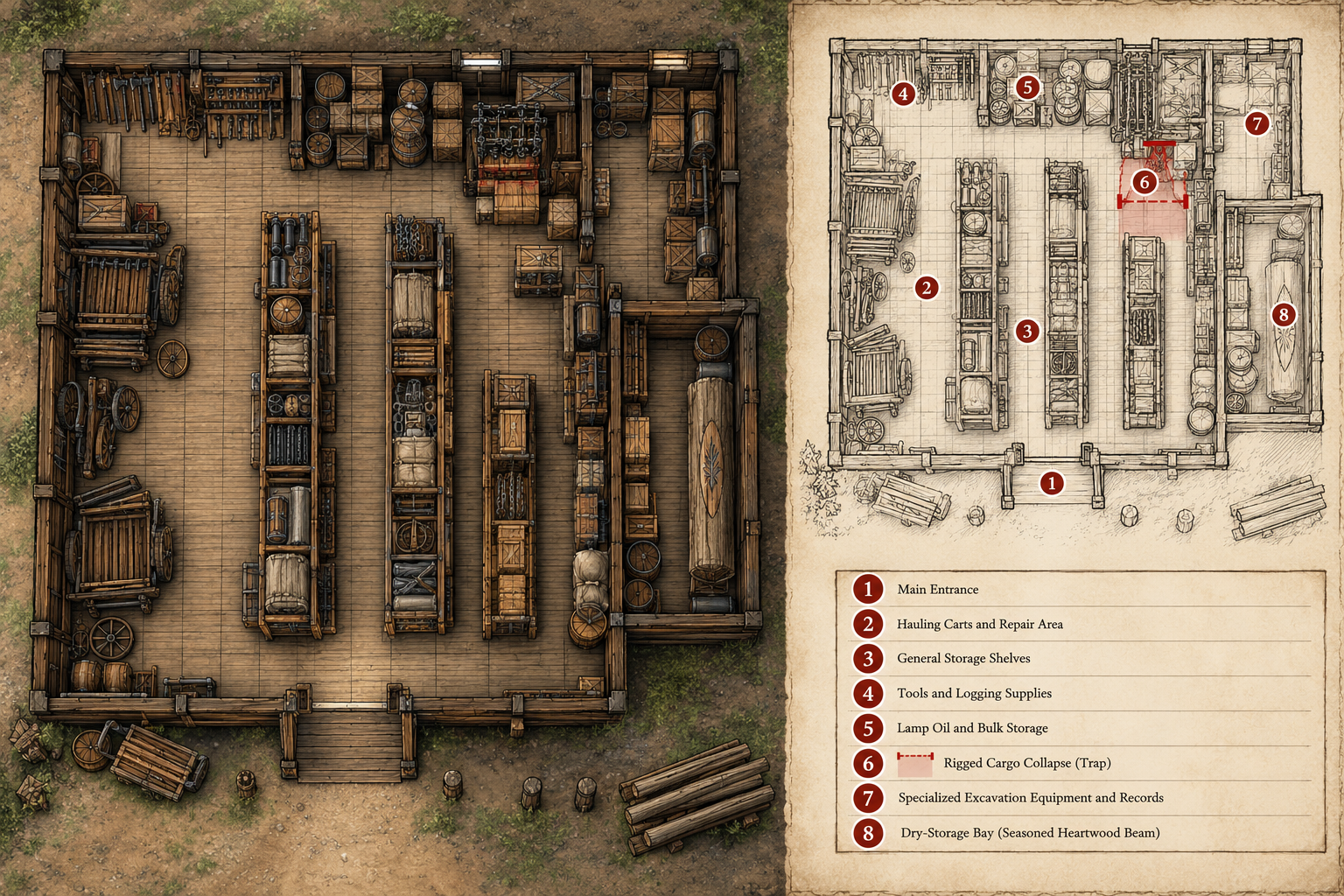
The storehouse is packed tightly with the practical clutter of a remote timber camp. Coils of rope hang from wall pegs beside axes, splitting wedges, spare saw teeth, heavy canvas, replacement chains, iron fittings, and crates of nails and hardware.
Rows of shelves disappear toward the back beneath stacked barrels of lamp oil and bundles of timber bracing. Several hauling carts stand against one wall with their wheels removed for repair.
Farther in, the inventory becomes harder to explain.
Heavy picks lean beside stone wedges. Narrow lengths of drainage pipe are stacked beneath rolls of stiff canvas. Iron pulleys, oversized chain, pry bars, replacement tool heads, and reinforced cart fittings fill crates marked as ordinary maintenance supplies.
Near the rear of the building, the shelves crowd together around a narrow aisle. Several heavy crates have been stacked beneath an overhead storage frame laden with chain and iron fittings.
The Storehouse provides physical proof of the suspicious purchasing patterns the party may already have uncovered in Macridi. Almost every item stored here has a legitimate use somewhere in a large logging camp. The problem is the combination, quantity, and pattern of use.
Reiver's Right has been buying enough lighting, drainage, ventilation, shoring, stoneworking, and heavy hauling equipment to support a substantial underground work site.
Someone has also recently rigged a section of the rear aisle to collapse on anyone attempting to reach the specialized equipment and associated records. The trap is concealed among ordinary storage materials and is not immediately obvious.
No check is required to notice that the storehouse contains equipment that looks different from ordinary forestry supplies. Picks, stone wedges, drainage pipe, heavy pulleys, reinforced cart hardware, and large quantities of lamp oil are plainly visible.
A check is required to understand what the equipment suggests when considered as a whole.
The characters can examine the accessible equipment without approaching the trapped rear aisle. Searching the remaining inventory and the more revealing freight records requires proceeding farther into the building.
Environmental Hazard
Rigged Cargo Collapse
The narrow aisle leading into the rear storage area contains a recently improvised mechanical trap. A concealed ankle-high tripline runs between the shelving and a stack of heavy crates.
Disturbing the line releases an overhead retaining pin, dropping suspended chain and iron fittings while destabilizing several crates. Falling cargo crashes into the aisle, potentially injuring or trapping anyone beneath it.
Hazard Rigged Cargo Collapse — Hazard 1
Detection Stealth DC 17 (trained)
Disable Thievery DC 15 (trained) or Crafting DC 16
Trigger A creature crosses the trapped aisle and pulls the tripline.
Use the separate Rigged Cargo Collapse hazard for its complete statistics, Reflex saves, damage, immobilization, Escape checks, and aftermath.
The trap should be encountered naturally as the party explores the rear of the building. Do not announce its presence simply because the characters enter the Storehouse.
Characters who detect the tripline can disable the mechanism or carefully step over it. Warned characters can follow the same safe route, although the trap remains armed.
The trap does not need to be triggered or destroyed for the party to continue exploring. The characters may also attempt to reach the rear supplies through or around the crowded shelving, at the GM's discretion.
If triggered, the fallen cargo makes the affected squares difficult terrain until cleared. The contents of the broken crates provide further physical evidence of excavation equipment.
Challenge 1: Identify the Excavation Equipment
Characters familiar with construction, mining, engineering, or heavy labor can examine the equipment and determine what kind of work it was intended to support.
Primary Check Crafting DC 16, Mining Lore DC 14, Engineering Lore DC 15, or Labor Lore DC 15
Critical Success The character recognizes a complete underground-work supply pattern: stone picks and wedges for excavation, heavy timber and hardware for shoring, chain and pulleys for lifting, carts for spoil removal, drainage pipe for groundwater, ventilation canvas for confined passages, and enough lamp oil to illuminate a large work site without natural light. Clue: This equipment was assembled to sustain a substantial subterranean excavation, not merely occasional foundation or road work.
Success The combination of stoneworking, shoring, drainage, ventilation, lighting, and heavy hauling equipment is excessive for the visible logging operation. Clue: Reiver's Right was supporting significant work underground.
Failure Many of the individual items could plausibly be used for roads, foundations, logging, or erosion control. The character cannot confidently identify a single purpose connecting them.
Critical Failure The character interprets the unusual equipment as an oversized but otherwise ordinary maintenance stockpile.
The rear section contains specialized excavation hardware and the most useful shipping and inventory records. The trapped aisle lies along the normal route to these materials.
The trap was assembled recently from ordinary Storehouse supplies. Its position suggests that someone wanted to discourage further investigation of the equipment and records.
Once the trap has been detected, disabled, bypassed, or triggered, characters can examine its construction using the separate hazard's Examine the Trap challenge.
Do not automatically reveal who constructed the trap. Hendrick, another Golden Hand agent, or a trusted member of the Lower Works could have rigged it during the camp's final hours.
Tucked beneath a low shelf in the rear storage area is a small, weather-stained canvas satchel that does not belong with the Storehouse inventory. It lies near the freight records and shipping tags, beyond the normal approach to the trapped aisle.
The name Derrin Hale is written in charcoal inside the flap, and the initials D.H. have been scratched into the brass buckle.
No check is required to identify the satchel once the characters can safely search the rear storage area. Its contents establish that Derrin reached Reiver's Right and was involved in moving freight through the Storehouse.
Treasure · Personal Effects
Derrin's belongings are still packed as though he expected to leave quickly. Beneath a spare shirt and a pair of river worker's gloves is a small oilcloth packet containing the advance he received for the freight job.
- Coin: 8 gp in mixed Druman coin.
- Gear: A 50-foot coil of rope, a small waterproof tinderbox, a whetstone, and several lengths of waxed cord.
- Clue: The unusually generous payment supports Derrin's claim that he was being paid for discretion as much as for ordinary freight work.
Derrin definitely reached Reiver's Right and spent at least a short time moving freight into the Storehouse. He noticed that some shipments were deliberately separated from the camp's ordinary inventory and handled by Hendrick's trusted men.
The satchel does not reveal Derrin's fate. He may have fled with the workers, disappeared during the camp's collapse, or become separated from the others. His abandoned belongings establish only that he did not depart Reiver's Right under ordinary circumstances.
Returning the letter or news of its discovery to Prophetess Maelin Vos advances The Empty Private Chamber sidequest.
Challenge 2: Audit the Remaining Inventory
Shipping tallies, shelf marks, crate numbers, and inventory tags allow the party to compare what the Storehouse received with what actually remains. The most useful records are kept toward the rear of the building.
Primary Check Society DC 16, Mercantile Lore DC 15, Perception DC 16, or Accounting Lore DC 14
Critical Success The character reconstructs a clear pattern of missing equipment. Large quantities of lamp oil, structural braces, picks, wedges, chain, pulley assemblies, drainage pipe, and reinforced hauling hardware were received but are no longer present. Clue: The missing supplies were not consumed by the visible camp. Someone has been moving them elsewhere in substantial quantities over an extended period.
Success The inventory records show that much more specialized equipment entered Reiver's Right than remains in the Storehouse. Clue: Large amounts of equipment have already been transferred to another work site.
Failure The Storehouse records are too fragmented to distinguish missing supplies from ordinary consumption and breakage.
Critical Failure The character concludes that the missing inventory was probably consumed by normal camp maintenance.
The Storehouse does not identify the destination of the missing equipment. No crate is marked Lower Works, and no convenient map directs deliveries underground.
What the room establishes is simpler and more useful: specialized excavation supplies arrived at Reiver's Right in significant quantities, and much of that equipment is somewhere else now.
Evidence at the Smithy, Carpentry Shed, Log Chute & Hoist, and eventually the Lower Works can progressively answer where it went.
Challenge 3: Trace the Shipping Marks
The specialized supplies arrived through several different commercial intermediaries. Most crates bear ordinary freight marks, but careful comparison reveals repeated details among shipments that supposedly came from unrelated suppliers.
Primary Check Perception DC 17, Mercantile Lore DC 16, or Society DC 17
Critical Success The character identifies the same small authorization mark on several crates, invoices, and freight tags: a golden hand curved around a coiled serpent . The shipments came through different companies, but their internal markings suggest a common financial authority. Clue: The same concealed commercial network that financed the unusual purchases also controlled their delivery to Reiver's Right.
Success Several supposedly unrelated shipments share identical freight notation, numbering conventions, and authorization marks. Clue: The suppliers are probably connected through the same hidden commercial interest.
Failure The crates show a variety of ordinary merchant and freight marks, but no useful pattern emerges.
Critical Failure The character assumes the differing marks simply reflect normal subcontracting between merchants.
The hand-and-serpent symbol should be evidence of a connection, not an instant explanation. Characters who have already encountered the mark elsewhere can immediately recognize it.
Characters who have not yet identified the Golden Hand simply learn that several supposedly unrelated suppliers share the same concealed authorization mark.
Do not place an openly labeled Golden Hand shipping manifest here. The organization has spent years hiding the Lower Works behind legitimate businesses and mundane paperwork.
If the party accepted Pheyess's request in Old Macridi, a locked dry-storage bay near the rear of the Storehouse contains the oversized darkwood beam he described.
The bay lies beyond the normal approach to the trapped aisle. Characters who have detected and bypassed the tripline can reach it safely. The trap does not need to be triggered to complete this objective.
Pheyess's carved double-leaf artisan mark remains clearly visible on one end. The beam has seasoned here for years and shows no visible black-sap corruption.
Following Pheyess's instructions, the party can confirm the beam's identity and condition without a Crafting check.
The beam is too large and heavy to casually carry away. Securing it in place, clearly marking it for later recovery, or arranging transport through the Lower Landing is sufficient to advance the task. Pheyess's established reward remains payable when the heartwood is actually secured for him.
If the Rigged Cargo Collapse has been triggered, the beam remains undamaged inside its separate dry-storage bay. Clearing the aisle or finding another way to reach the bay allows the party to complete the objective normally.
The Storehouse turns suspicious paperwork into physical evidence. Reiver's Right did not merely purchase excessive supplies on paper—the specialized equipment is here.
A thorough investigation should establish three things: the camp was equipped for substantial underground work, much of that equipment has already been moved somewhere else, and the unusual shipments connect back to the same concealed commercial network associated with the hand-and-serpent mark.
The improvised cargo trap introduces a fourth question: why would someone deliberately make the rear of an otherwise ordinary Storehouse dangerous to search?
The Storehouse should strengthen the party's case for the Lower Works without revealing their entrance. That confirmation belongs later, when the physical trail of equipment finally leads beneath the bluff.