E11 — Carpentry Shed
Background art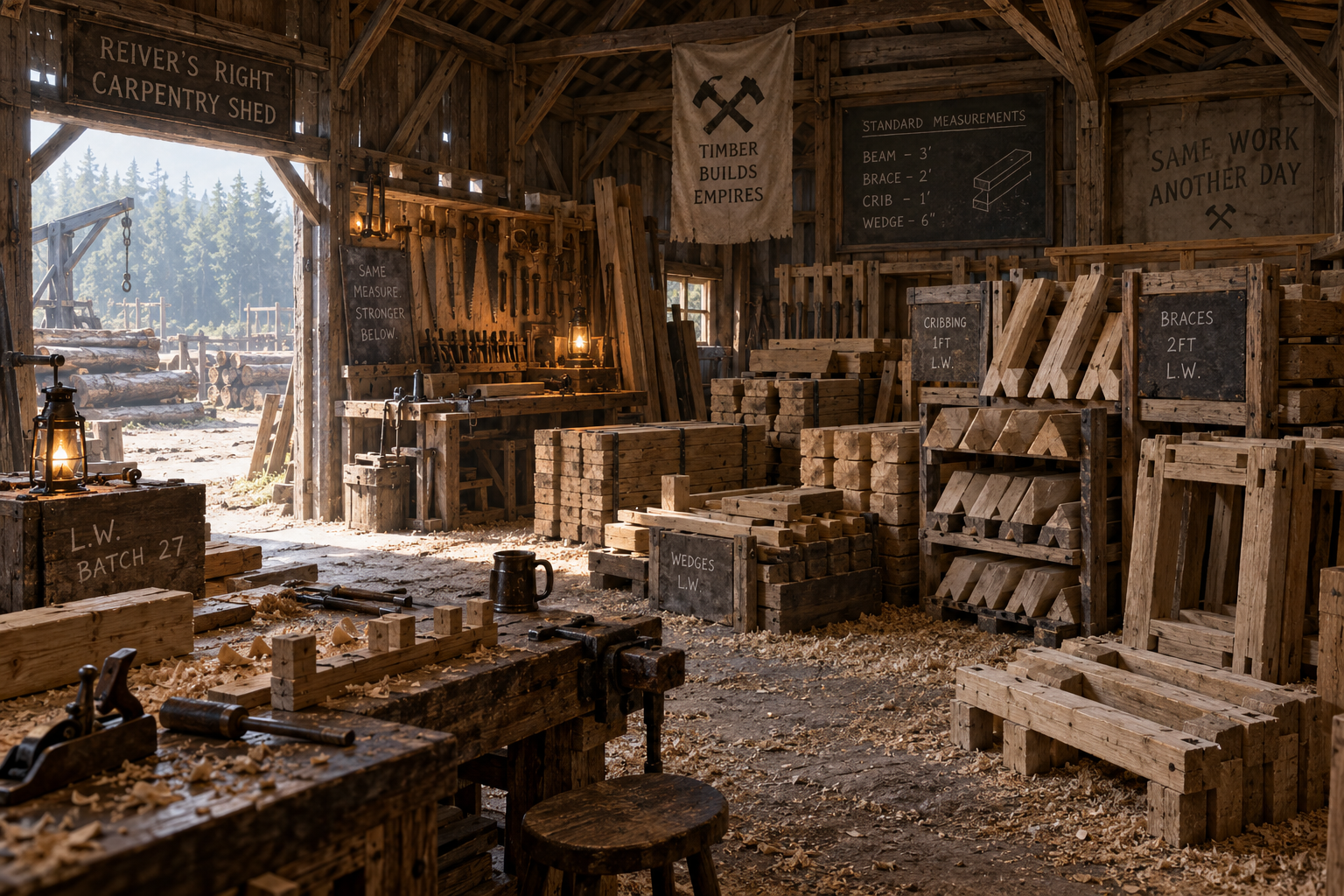
Carpentry Shed
Built for Somewhere Below
The carpentry shed smells of sawdust, pitch, and freshly cut pine. Workbenches run beneath racks of handsaws, augers, mallets, planes, and measuring jigs. Offcuts cover the floor, and several unfinished pieces remain clamped exactly where their makers left them.
Most of the finished lumber is strangely uniform. Short heavy beams are stacked beside thick braces, wedges, cribbing blocks, and square frames built to the same few measurements over and over again.
Whatever these pieces were made for, Reiver's Right needed a great many of them.
The Carpentry Shed provides some of the clearest physical evidence that the camp's timber was being diverted into the Lower Works. The pieces being produced here are not furniture, building trim, wagon parts, or ordinary logging equipment. They are standardized structural components designed to be carried into confined spaces and assembled quickly.
If the party has already concluded that Reiver's Right contains a hidden underground excavation, no check is required. The purpose of the lumber is immediately obvious: these are tunnel supports, braces, cribbing, and framing components.
This location should reward players for connecting earlier clues. Once they have identified the pattern, do not make them roll simply to confirm what they have already reasoned out.
Challenge: Understand the Carpentry
Characters who have not yet identified the Lower Works can study the dimensions, cuts, and repeated construction patterns to determine what the components were intended to support.
The repeated dimensions matter as much as the shape of the lumber. Measuring jigs have been nailed directly to several benches so workers could reproduce the same pieces quickly without marking each one individually.
Bundles of completed braces are tied together in identical sets. Chalk marks on the wall record batches rather than individual projects, suggesting continuous production over a long period.
This was not a carpenter improvising supports for an emergency repair. The shed had become a small production line supplying a recurring need.
Challenge: Estimate the Scale
The amount of waste lumber, completed components, and repeated batch markings can reveal how extensively these supports were being used.
Several finished bundles are marked only with simple chalk notations such as L.W., Lower, or batch numbers matching the abbreviations found on repair tags in the Smithy and assignments in Hendrick's records.
If the party has already connected L.W. to the Lower Works, this requires no additional check.
The evidence here should feel cumulative. Hendrick's records describe the work, the Storehouse supplied it, the Smithy repaired its tools, and the Carpentry Shed manufactured the timber supports needed to keep it operating.
The Carpentry Shed works best as an investigation location rather than another combat scene. Its purpose is to let the party look at something mundane and realize exactly what it means.
If you want an environmental hazard here, an unstable rack of heavy finished beams can serve as a separate Level 1 collapsing-lumber hazard. Keep the hazard in its own HTML card so it can be added or removed without changing the investigation scene.
The Carpentry Shed should confirm that the timber camp itself was being used to support the concealed excavation. Reiver's Right supplied more than labor and cover: its logging operation provided a constant source of beams, braces, cribbing, wedges, and frames for the underground work.
By this point, a party that has followed the evidence should no longer be asking whether something was happening beneath Reiver's Right. The remaining questions are where the entrance is, how large the Lower Works are, and what the Golden Hand was trying to reach.