E4 — The Twin Oathstones
The Twin Oathstones
Palakar Forest · Two blightseeds · Two-stage trap encounter
Two weathered oathstones lean toward one another like hands about to clasp. Their ancient runes are webbed with black, thread-thin roots, and a sickly amber shine leaks through cracks in the earth. At the foot of each stone, a dark nodule no larger than a baseball pulses beneath a skin of translucent sap. Between the stones, roots lie stretched across the path as taut as wire.
GM — Two Seeds, One Defense
There are two separate, baseball-sized infernal blightseeds, one embedded at the base of each oathstone. Each is an active node in the root network. The objective is to expose and pour the Blightseed Antidote directly onto both seeds. One treated seed is not enough; its twin continues feeding contamination through the joined roots. The ancient oathstones themselves are not the targets and need not be damaged.
There are no creatures stationed here. The encounter's only opposition is the attached Twin Oathstones — Linked Root Defenses trap, a two-stage hazard triggered as the party attempts to reach the seeds. It is environmental defense, not a patrol encounter.
Finding the Seeds
The left-hand seed rests in a shallow root cradle beneath loosened moss. The right-hand seed is half-buried among splintered roots and stone chips. A careful search reveals both before the party commits. Nature DC 18 identifies the two nodules as living blightseed growths rather than mere sap deposits. Perception DC 18 (trained) notices the taut black trigger-roots and the swollen spore sacs linked between the stones.
As you draw near the first nodule, the dark roots cinch tight. The second seed answers with a dull red pulse, and a cluster of swollen blisters opens along the stone. The two growths are reacting to one another.
Running the Two-Stage Trap
- Stage One — Snaring Roots: Crossing the inner threshold or reaching for either seed without first disabling its root trigger snaps a barbed root around the intruder. Use Stage One of the trap artifact. PCs can spot, disable, or avoid the trigger before advancing.
- Stage Two — Spore Retaliation: Once the first seed is exposed, disturbed, or dosed with Blightseed Antidote, the linked second growth vents an irritant spore cloud. Use Stage Two of the same trap artifact. The group may disable the spore sacs before treating the first seed, or endure the burst and proceed.
Stage Two triggers at most once. Neither stage respawns after being safely disabled. Treat both stages as one linked hazard for award purposes, not two independent encounters.
Neutralization — Both Seeds Must Die
At each stone: get adjacent to the baseball-sized seed; if covered, clear the loose roots or moss with one Interact action; then pour one Blightseed Antidote dose directly onto the exposed growth with one Interact action. one Blightseed Antidote dose per seed, for two Blightseed Antidote doses total. Blightseed Antidote applied to the surrounding stone, soil, or surface water has no effect. The seed puckers, turns ash-gray, and collapses when properly treated. Ordinary weapon damage can break its shell but does not reliably neutralize the infernal core; the antidote is the required finish.
Once the first seed dies, the remaining seed flares and the connecting roots visibly tense. When the second dies, the black threads contract, the red pulses cease, and the link between the oathstones falls limp. The blight's local anchor is neutralized, although contamination elsewhere in the root network persists.
Discovery, Alternatives, and Outcome
Players can approach cautiously, search for both triggers, use appropriate tools to disable them, or choose to take the risk and pour the Blightseed Antidote under pressure. The linked defenses are the challenge; do not add a creature fight. Nature or Society DC 18 distinguishes the older Cedar Court boundary monument from the newer roadwork, but those structures are background clues rather than additional objectives.
Report whether both blightseeds were destroyed and whether the paired growths reacted across the buried roots. Destroying only one leaves an active infection source. Destroying both protects this crossing and provides evidence that the blight is spreading through coordinated, interconnected nodes.
This site requires the Blightseed Antidote, a custom seed-core treatment. Each baseball-sized blightseed needs one complete seed-antidote dose applied directly to its exposed core (two doses for these two seeds). Watercourse Neutralizer does not work on seeds, even when poured over their root network. Seed antidote does not purify waterways. Interact actions used to uncover and dose seeds are specific to this encounter; no generic PF2e item grants this ability.
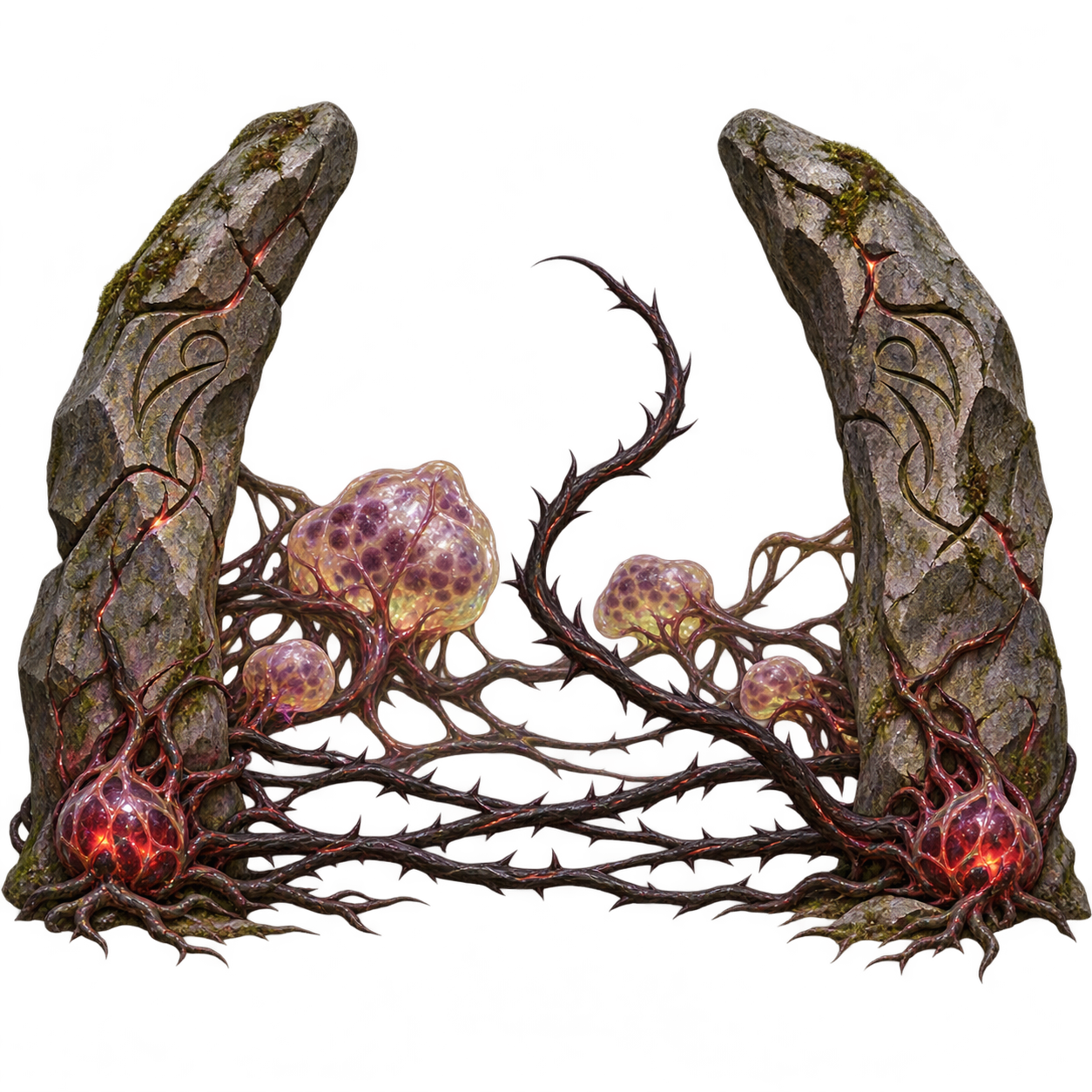
Twin Oathstones — Linked Root Defenses
Environmental · Plant · Trap · Two linked stages, one encounter
Stealth DC 18 (trained) to identify the black triproots and the connected swollen spore sacs.
Description Two baseball-sized infernal blightseeds lie beneath opposite oathstones. Their defensive roots are linked: one ensnares intruders while the other retaliates with an irritant spore release.
Stage One — Snaring Roots
Disable Thievery DC 18 (trained) to release the root's tension knot, or Nature DC 18 to pin the trigger root safely away from the approach.
Trigger A creature crosses the root line or touches a blightseed without first bypassing or disabling the snare.
Reaction — Root Lash The target attempts a DC 18 Reflex save. Critical success: unaffected. Success: half of 2d6 piercing. Failure: 2d6 piercing and immobilized until Escape (DC 17). Critical failure: double damage and immobilized until Escape (DC 17). The root lash activates only once; cutting or releasing the snare after it fires ends its restraint.
Stage Two — Spore Retaliation
Disable Crafting DC 18 (trained) to plug the visible vent sacs, or Nature DC 18 to safely strip the spore blisters from the root link. This can be attempted before Stage Two triggers.
Trigger The first seed is uncovered, damaged, or treated with Blightseed Blightseed Antidote while the spore sacs remain armed, whether or not Stage One fired.
Reaction — Bitter Bloom A thick cloud billows in a 10-foot emanation centered on the disturbed seed. Creatures in the area attempt a DC 18 Fortitude save. Critical success: unaffected. Success: no damage, but coughing and watering eyes. Failure: 1d6 poison damage and sickened 1. Critical failure: 2d6 poison damage and sickened 1. The cloud dissipates at the end of the triggering turn; this stage triggers only once.
Ending the Hazard
Required objective: Expose and pour one dose of Blightseed Blightseed Antidote onto each seed (two Blightseed Blightseed Antidote doses total). Clearing each seed, if needed, costs one Interact action; pouring the dose costs one Interact action while adjacent. A properly dosed seed shrivels and dies immediately. Both must be dosed to extinguish the joined blight. Damaging the shell alone is not a substitute for Blightseed Blightseed Antidote treatment.
Reset Neither defense resets during this encounter. If both seeds are neutralized, all roots and spore sacs become inert.
Run these as two successive stages of one custom hazard, not two simultaneous monster turns and not two separate XP awards. Players can discover and disable either stage before triggering it; if the first seed is treated without disarming Stage Two, its retaliation activates. No creatures are present. The Blightseed Antidote is the victory condition.
Both seeds must receive separate doses of Blightseed Antidote. Watercourse Neutralizer cannot kill either seed. This is a custom scenario objective, not a general Remaster item action. The attached defense is a two-stage, one-encounter simple hazard with no ongoing initiative routine.