E6 — Bunkhouses / Workers' Cabins
Background art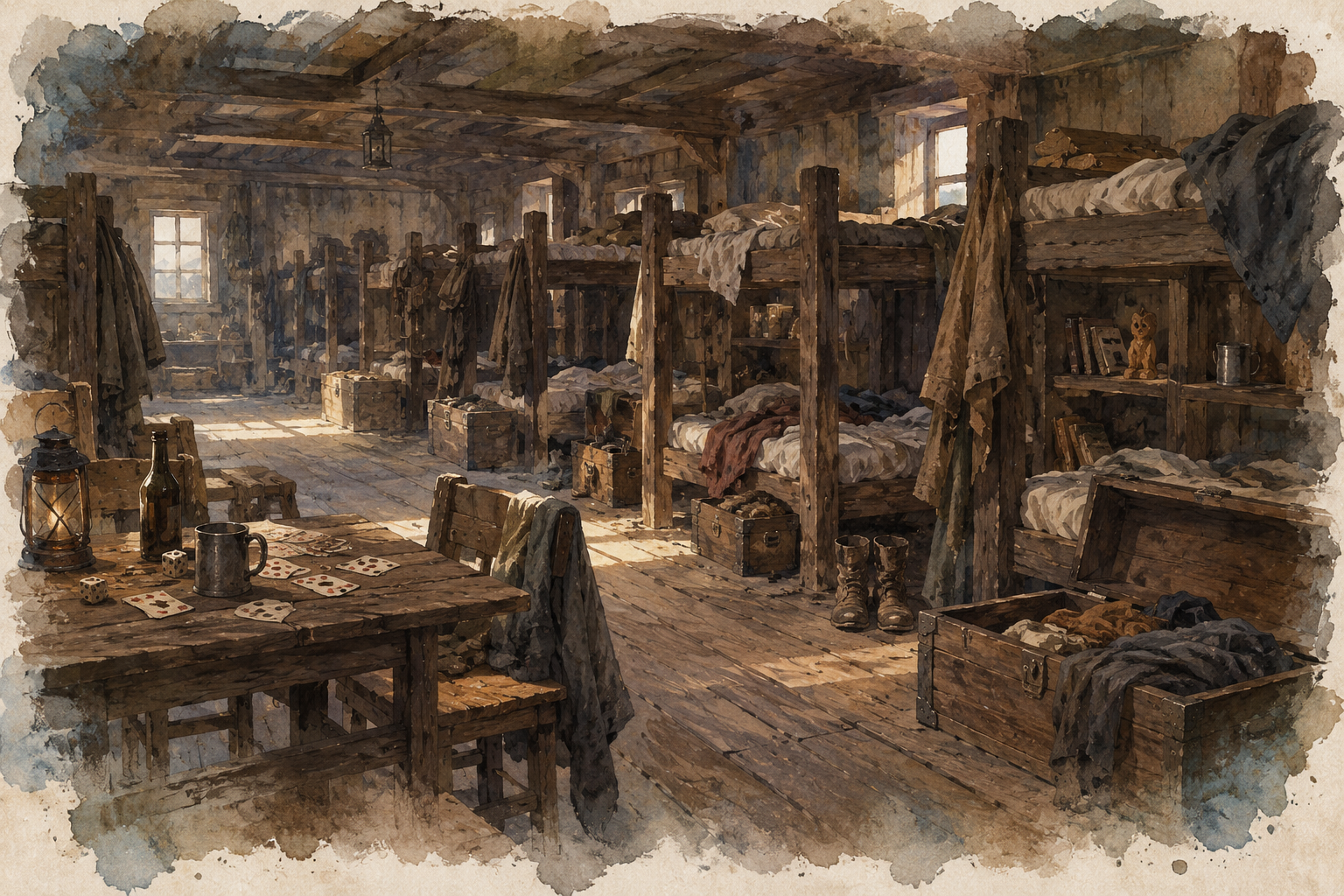
Workers' Bunkhouses
The People Who Expected to Come Back
Rows of narrow bunks fill the workers' cabins, packed closely enough that a person could cross half the room by stepping from bedframe to bedframe. Blankets remain tangled from sleep. Mud-stained boots sit beneath beds. Cheap playing cards, letters from home, carved wooden figures, shaving kits, spare shirts, and little personal hoards occupy shelves and footlockers.
A half-finished game of cards still covers one small table. Someone left a pair of dice where they fell.
Nothing here looks properly packed. Some beds are stripped of blankets, a few footlockers stand open, and several shelves have conspicuous empty spaces. But most of the workers' belongings remain exactly where they were left.
The bunkhouses should humanize the missing workforce. Reiver's Right was not an empty company site; more than fifty people lived and worked here. Fifty workers eventually fled the camp in two groups, leaving behind wages, clothing, personal correspondence, tools, keepsakes, and much of what they owned.
Their departure was hurried rather than orderly. Most had expected to return to their beds until the worsening corruption and Hendrick's disappearance made remaining at Reiver's Right untenable.
No check is required to establish that the workers left in haste. Spare boots, traveling cloaks, money purses, letters, tools, and personal belongings remain throughout the cabins. Some workers managed to collect food, blankets, and a few essential possessions, but many left with little more than they could carry.
Several beds appear to have been slept in shortly before the camp went silent. The abandoned possessions suggest that the workers had not anticipated leaving permanently.
Careful observation also reveals that the cabins were not all abandoned at precisely the same moment. Some belongings were hastily collected, while others remain completely undisturbed.
Challenge 1: Search the Cabins
Careful examination of the workers' clothing and equipment reveals that some members of the camp had recently been working somewhere very different from the surface logging areas.
Do not turn every bunk into a puzzle. Most of what the characters find should be ordinary evidence of the people who lived here: letters from spouses, crude jokes scratched into bedframes, IOUs from card games, sketches, spare socks, cheap liquor, and small amounts of saved coin.
A few notes and letters can contain fragments of the growing unease around Reiver's Right. None should explain the entire conspiracy by itself.
- A worker complains about carts moving after midnight even though no timber shipments were scheduled.
- Another mentions being told by a guard to stay away from the river bluff after dark.
- One letter jokes that certain crews have become "moles" because they disappear for days and return covered in pale clay.
- A worker complains about hammering beneath the camp continuing long after the sawyard had gone quiet.
- A rough note mentions two laborers reporting headaches, strange dreams, and black residue beneath their fingernails after working a special shift.
- One bunk has been untouched for several days. Its owner was supposedly reassigned to Lower Works and never returned for his belongings.
Challenge 2: Piece Together the Workers' Rumors
The notes are fragmentary and written by people who did not understand the larger operation. Comparing several of them can reveal a common pattern.
From somewhere near the back of the cabin comes a faint scrape.
Then silence.
A moment later, something beneath one of the lower bunks shifts again.
Halven Dorr — The Missing Visitor
The figure beneath the bunk is Halven Dorr, assistant to Orvik Brasshand of the Watchmaker's Loft in Old Macridi. Halven is not one of Reiver's Right's workers. Orvik sent him to the logging camp to inspect and purchase finished darkwood for several precision commissions.
A previous shipment had contained a small infestation beneath the grain, so Halven had been instructed to inspect replacement stock personally before arranging its return to Old Macridi.
Halven arrived while Reiver's Right was still functioning, but remained long enough to witness conditions deteriorate rapidly. He is dehydrated, exhausted, frightened, and showing early symptoms of exposure to the infernal blight, but he has not transformed into a monster.
Black lines have begun to appear beneath the skin of one forearm, and dried oily residue stains his sleeve. Several shallow scratches mark the same area. Halven believes something from the camp has gotten inside him and is terrified that he may be changing into one of the corrupted creatures he saw elsewhere.
When the workers began evacuating, Halven was already showing symptoms. He refused to join either group, fearing he might infect them or slow them down. Instead, he retreated into the bunkhouses and concealed himself.
He has spent the intervening days hiding beneath a lower bunk, surviving on whatever food and water he could reach without exposing himself.
This encounter should begin as an attempt to calm and help a terrified missing man, not as combat.
If the party has already spoken with Orvik Brasshand about Halven's disappearance, the identification is immediate once Halven gives his name.
Halven still carries a compact leather tool case containing calipers, a small magnifying lens, a grain probe, chalk, and several notes describing pieces of darkwood he inspected before the camp collapsed. These items support his explanation that he came to Reiver's Right on legitimate business rather than as part of the logging workforce.
Finding Halven resolves the central question of Orvik's request—he did reach Reiver's Right—but his condition and eyewitness account create much larger questions about what happened after his arrival.
Halven fears that the black veins spreading through his arm will transform him like the creatures elsewhere in camp. Food, water, and reassurance may help, but showing him that the blight can be held in check earns his confidence much more quickly.
If the characters administer the blight-stabilizing treatment, the burning in Halven's arm subsides and the dark veins stop advancing. The treatment stabilizes the blight for 24 hours; it does not cure the infection.
Halven watches the dark veins beneath his skin, slowly flexing his injured hand. His grip on the woodcutting knife loosens.
"It's stopped. Gods, I think it's actually stopped."
He looks up at you. "How long will it last?"
When you explain that the relief is temporary, he swallows hard, then sets the knife aside. "All right. Ask what you need to ask."
Temporary relief: The treatment halts progression for 24 hours but leaves the underlying corruption in place. Halven asks the characters to help him return to Old Macridi and reach someone capable of treating the infection. Feeding, hydrating, or tending his injuries can improve his immediate condition, but does not independently suppress the blight.
Challenge 3: Calm Halven Dorr
Skip this check if the party has already administered the blight-stabilizing treatment. That treatment automatically earns Halven's cooperation; a further Diplomacy check is optional and only needed to obtain additional personal details. Otherwise, resolve the challenge below.
Halven grips a woodcutting knife and warns the characters to stay back. He is frightened, sleep-deprived, and struggling to distinguish actual threats from the sounds and memories of what happened in the camp.
Halven was an outsider visiting Reiver's Right on legitimate business. He was not a member of the Golden Hand and was never employed by the logging camp. His purpose was to inspect finished darkwood before arranging its purchase for Orvik Brasshand.
Because Halven spent time examining lumber, speaking with workers, and waiting for suitable stock to be prepared, he observed more of the camp's activity than an ordinary passing visitor might have.
If calmed, he can provide several important eyewitness details:
- The Darkwood: Some of the finished timber showed unusual dark staining or fine contamination beneath the grain. Halven initially believed this was the same kind of infestation Orvik had sent him to investigate, but he became increasingly uncertain.
- The Lower Crews: Hendrick regularly reassigned workers to a job everyone called the Lower Works. Workers said it involved bluff stabilization and drainage.
- Night Work: Halven noticed crews leaving after the evening meal and returning shortly before dawn. Some came back covered in pale gray clay and stone dust despite supposedly working at a logging camp.
- The Equipment: Halven saw carts carrying braces, picks, chains, lamp oil, pipe, and other heavy equipment toward the river-bluff side of camp.
- The Consultant: A well-dressed outsider arrived shortly before conditions worsened. Halven heard workers refer to the visitor only as Hendrick's alchemist or the consultant.
- The First Sick Workers: Several members of the Lower Works crews began complaining of burning skin, strange dreams, and black residue on their hands and clothing.
- The Final Night: Shortly before the camp collapsed into chaos, Halven heard shouting near the bluff followed by a deep impact or tremor beneath the ground.
- Hendrick's Disappearance: Halven heard workers discussing Hendrick carrying a piece of black root-growth in his chest pocket. The thing eventually penetrated his clothing and embedded itself in his skin. Workers attempted to remove it, but Hendrick refused. After behaving increasingly strangely, he disappeared before dawn.
- The Evacuation: Fifty workers fled in two groups, one heading for the Cedar Court and the other for the Court of Endless Revelry. Halven remained behind because of his symptoms and his fear that he might infect the refugees.
- The North Road: Both groups avoided the North Road because of rumors that the blight was especially dangerous at the crossroads near the Pulgari Estate.
- The Missing Workers: A few workers were already unaccounted for when the evacuation began. The refugees did not want to remain at Reiver's Right long enough to search for them.
Halven cannot confirm whether either refugee group reached its intended destination. He knows nothing of the Golden Hand's larger plans or the true origin of the infernal blight.
By the time the workers decided to evacuate, Reiver's Right had become increasingly dangerous. Hendrick had disappeared, several laborers were missing, and frightening rumors circulated about the corruption spreading beneath the camp.
Fifty workers gathered whatever supplies they could carry and abandoned Reiver's Right. They divided into two groups, hoping that the fey courts might offer sanctuary or assistance.
Group One — Cedar Court: One group followed woodland trails toward the Cedar Court, avoiding the North Road and the approaches to the Pulgari Estate.
Group Two — Court of Endless Revelry: The remaining workers took another route through the forest toward the Court of Endless Revelry. They likewise avoided the crossroads where the blight was rumored to be especially severe.
Neither group's arrival is confirmed at this stage. The party can discover additional information about their fate during later encounters with the fey courts.
Halven remained hidden inside the bunkhouses rather than joining either group. His presence explains why the camp contains a living survivor even though the main workforce has departed.
The dark lines beneath Halven's skin are an early reaction to infernal blight exposure, not a fully established transformation like Hendrick's. Food, water, and ordinary treatment can help his exhaustion and injuries, but only the linked blight-stabilizing treatment stops the corruption from advancing for 24 hours; it is not a cure.
A Medicine or Nature DC 16 check determines that his symptoms are similar to the lignification caused by the Infernal Blightling, but far less advanced.
On a critical success, the character also notices that the corruption is concentrated around several shallow scratches on his forearm rather than spreading uniformly through his body. This suggests physical exposure to contaminated roots, sap, or infected timber rather than the embedded seed fragment responsible for Hendrick's transformation.
The Bunkhouses should make the disappearance personal. Fifty workers fled Reiver's Right in a hurried evacuation, leaving behind wages, letters, clothes, tools, and personal belongings because they had not expected to abandon their homes until the situation became intolerable.
Investigation adds a second conclusion: some workers were regularly being sent somewhere underground. Their clothing carries gray clay and stone dust, their own notes describe late-night activity and restricted bluff access, and Halven can confirm that carts loaded with excavation equipment were moving toward the Lower Works.
Halven also establishes that the workers split into two groups bound for the Cedar Court and the Court of Endless Revelry, deliberately avoiding the North Road crossroads near the Pulgari Estate.
His presence provides a separate thread into the mystery: an ordinary visitor sent to investigate questionable darkwood became trapped inside the disaster and exposed to the same corruption affecting the camp.
Most importantly, Halven's account supports the conclusion that the ordinary workforce was largely being used rather than initiated into the conspiracy. Hendrick and the Golden Hand knew far more about what was happening beneath Reiver's Right than the people doing much of the dangerous work.
The party should leave this location having found Orvik's missing assistant and gained several leads, but not a complete explanation of the conspiracy, the fate of the refugees, or the true source of the infernal blight.
Along one wall of the Carpentry Shed rests a separate stack of carefully selected finished darkwood, noticeably better prepared than the ordinary lumber elsewhere in the camp. The boards have been planed, trimmed, and set aside rather than mixed with the general stock.
These are the pieces Halven Dorr came to Reiver's Right to inspect on behalf of Orvik Brasshand. Orvik's previous shipment had contained an unacceptable infestation beneath the grain, so Halven was instructed to personally examine the replacement stock before approving it for transport back to Old Macridi.
Several boards bear small chalk marks, measurements, and inspection symbols made by Halven. A few have been rejected with a simple X, while others have been marked as acceptable. His abandoned inspection work shows that he was still evaluating the shipment when conditions at Reiver's Right deteriorated.
Against the far wall lies a neat stack of unusually dark timber, each board planed smooth and separated by narrow wooden spacers. Fine chalk marks run along the edges: measurements, short notations, circles around knots, and several decisive X marks.
One board has been partially scraped along the grain, exposing a thin dark discoloration beneath the polished surface.
A character examining the boards can determine that the darkwood itself is valuable and professionally prepared. The troubling feature is not obvious surface rot, but fine discoloration and residue occurring beneath the grain in several pieces—the same sort of defect that caused Orvik to reject the earlier shipment.
This does not by itself prove that the darkwood caused Halven's condition. It does establish that corruption had reached finished timber being prepared for export from Reiver's Right.