Cedar Court Amber
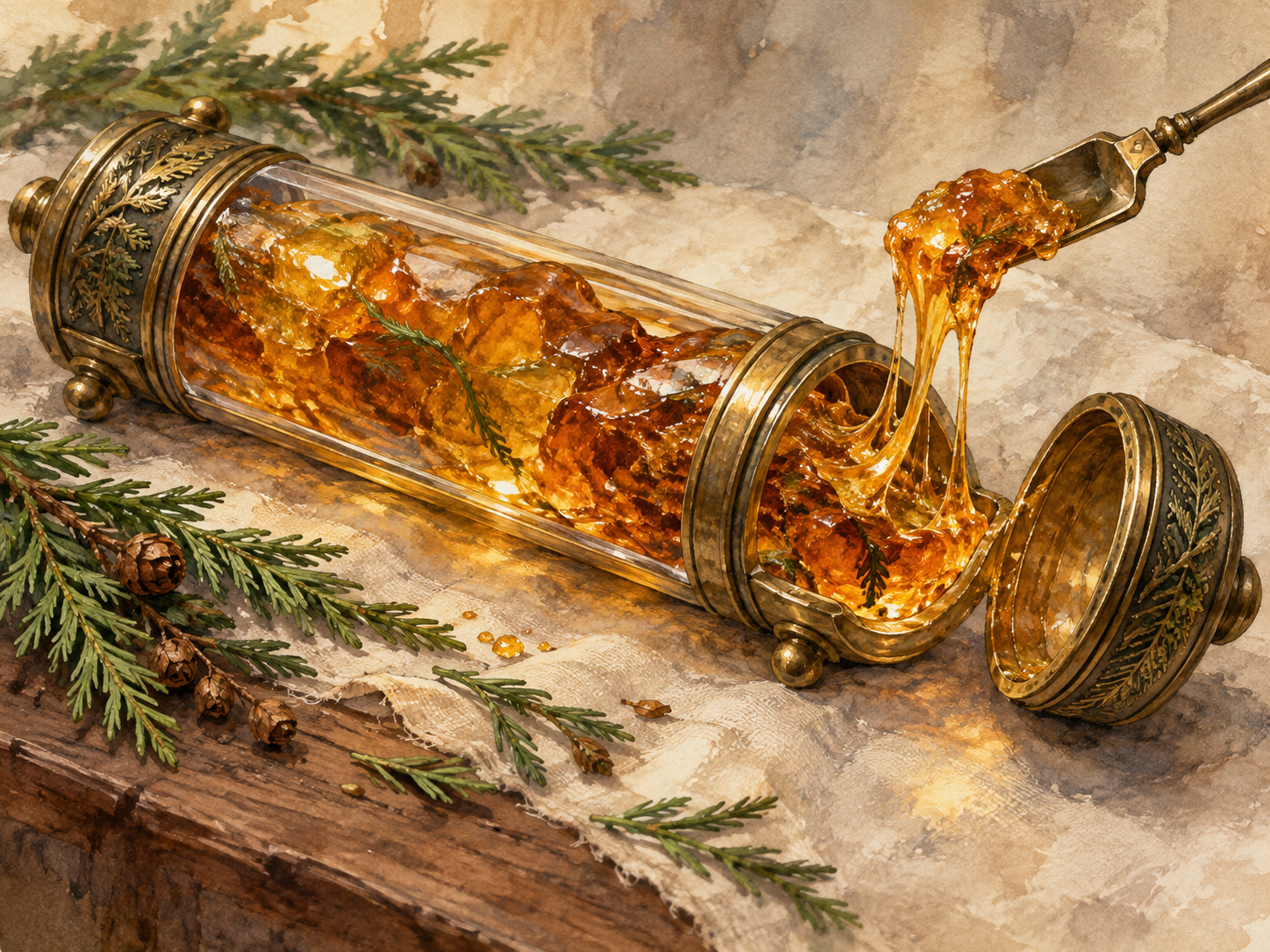
Golden Cedar Court Amber
A Precious Resin from the Golden Cedars of the Cedar Court
The substance is a deep translucent gold, darker than honey and streaked with faint green veining. Its exposed surface has hardened to a glossy amber crust, while the material beneath remains dense, tacky, and slightly yielding.
When cut or scooped, the resin stretches briefly in slow golden threads before separating. Freshly disturbed amber carries the sharp scent of cedar sap, crushed needles, and rain-soaked bark.
Known Properties
Golden Cedar Court Amber is highly prized by herbalists, apothecaries, and alchemists for its unusual stability and its strong affinity for living plant material.
- Preservative: The resin helps stabilize delicate botanical compounds and slows their degradation.
- Plant Affinity: Preparations containing the amber bind readily to sap, roots, bark, fungal fibers, and other plant tissue.
- Primal Character: Even a small sample carries a faint natural resonance associated with growth and preservation.
- Heat Sensitive: Excessive heat can damage the qualities that make the amber valuable, so it is usually softened or dissolved gently.
The Kerse Market
Among wealthy Kalistocrats in Kerse, Golden Cedar Court Amber has another, far more lucrative use.
When properly refined, an extremely thin application can preserve the color, texture, scent, and apparent freshness of fine organic materials for years. Rare flowers retain the appearance of having just been cut. Exotic fruits can remain flawless on a banquet table long after they should have spoiled. Fine woods, ceremonial garlands, botanical displays, and even elaborate arrangements of living moss and leaves can be maintained in an almost perfect state.
To the richest households of Kerse, this has become a discreet luxury. A reception hall decorated with impossible winter blossoms, a dining room displaying fruit from three distant climates, or a private shrine whose cedar boughs never brown can serve as a quiet demonstration of wealth, reach, and control.
The practice is especially prized because the best refinements leave almost no visible coating. To an observer, the preserved object simply appears unnaturally perfect.
The Cedar Court tightly controls the harvesting and export of the resin. Authorized quantities are small, expensive, and closely accounted for.
In Kerse, private demand greatly exceeds the legal supply. Wealthy buyers will pay extraordinary prices for undocumented amber, particularly samples large enough to supply an estate alchemist for months.
That price difference has created a profitable smuggling trade: amber stolen, diverted, or quietly purchased from unauthorized harvesters can be worth many times its ordinary alchemical value once it reaches the private markets of Kerse.
Handling the Amber
The softer interior can be cut or scooped with a clean knife, spatula, spoon, or suitable alchemical tool. Only a small quantity is needed for examination or laboratory work.
Careful handling is important. Dirt, metal filings, glass fragments, wax, or other contaminants can reduce the usefulness of a sample.