Irritant Mist Manifold
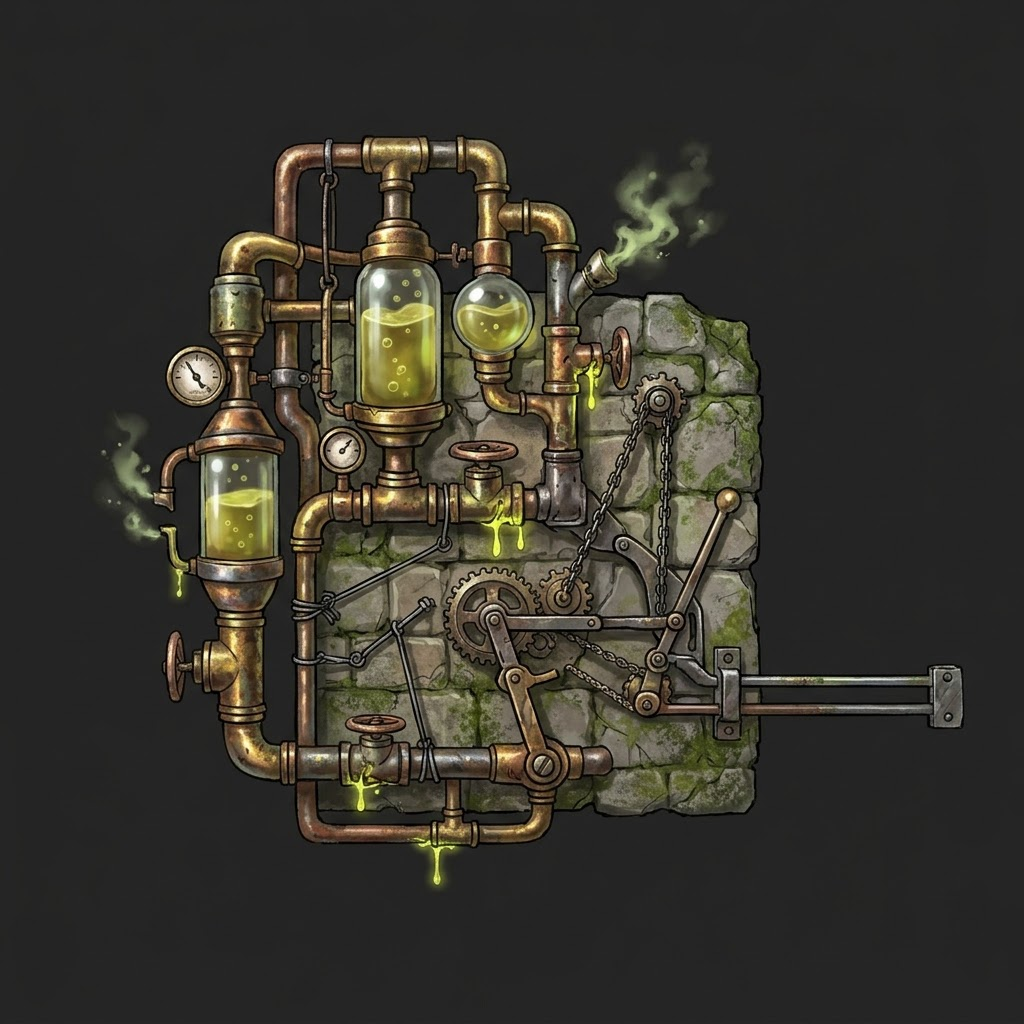
Irritant Mist Manifold
Alchemical · Inhaled · Mechanical · Poison · Trap
Stealth DC 18 (trained) to spot the irrigation valve linkage and spring-loaded locking bolt connected to the conservatory's rear door.
Disable (before triggering) Thievery DC 17 (trained) to block the valve and door-bolt linkage; Crafting DC 16 to isolate and vent the pressurized reservoir; or Nature DC 18 to identify and drain the irritant line. A successful disarm prevents both the mist release and the automatic door lock. Use the usual hazard-disabling rules; a critical failure triggers the trap.
Trigger The rear conservatory door is opened and a creature crosses its threshold while the manifold remains armed.
Effect The door slams shut behind the entering creature and locks automatically as a spring-loaded brass bolt engages. Simultaneously, pale mist fills the conservatory. All creatures already inside attempt a DC 18 Fortitude save. Failure: 1d6 poison damage and dazzled for 1 round. Critical failure: 2d6 poison damage, sickened 1, and dazzled for 1 round. On success or critical success, no additional effect. The mist is a one-time burst; don't call for fresh saves each round. It disperses 1 minute after the exterior vent is opened.
A sharp metallic clack echoes through the glasshouse. The door snaps shut behind you, and you hear a heavy bolt slam into place. Above, brass valves hiss; pale vapor jets from the irrigation pipes and curls between the plants.
Release the lock: An accessible brass inspection plate beside the door reveals the bolt release from either side. After the trap fires, use Thievery DC 17 (trained) to disengage it (Disable a Device, 2 actions), or Crafting DC 16 to disconnect and retract the linkage (2 actions). Success unlocks the door; failure leaves it shut. A critical failure jams the bolt, raising the next release attempt's DC by 2 until someone spends an Interact action clearing the jam. These checks do not release a second cloud—the reservoir is spent.
Pick the lock: A character with thieves' tools may instead use Thievery DC 17 to Pick a Lock (2 actions; one success is sufficient for this spring catch). Picking the lock opens the door but does not by itself neutralize the remaining valve linkage if the hazard has not yet fired.
Force Open: Athletics DC 22 (1 action; attack trait) to shoulder or pry open the locked door. On success the door breaks open; critical success opens it without breaking it; critical failure jams it, imposing a –2 circumstance penalty on subsequent Force Open attempts. Without a crowbar, prying takes the normal –2 item penalty. This DC is the latch's Thievery DC 17 + 5 for a locked door.
Smash the door: Use a conventional wooden door: Hardness 10, 40 HP, Broken Threshold 20. Subtract Hardness from each instance of damage to the door. At its Broken Threshold, the lock can no longer reliably hold; a character can push through using an Interact action. At 0 HP the door is destroyed. Physical attacks against the door are noisy.
Vent the mist: The labeled exterior vent can be reached inside the conservatory; opening it with an Interact action allows the cloud to dissipate over the next minute, regardless of whether the door has been unlocked. A successful Nature DC 18 or Crafting DC 16 check locates an unobvious vent control if necessary. The mist inflicts only the initial listed saving throw; it is not recurring damage.
Timing and fairness: Spring the trap only once someone has actually crossed into the room; do not trap a character in the closing doorway or add unlisted crushing damage. The door locks shut when the trap springs, but can be attacked or opened from either side. The slam and any attempts to break the door can be heard nearby; if the H1 handler and dogs remain, they may investigate. Otherwise do not invent automatic reinforcements.