Reiver's Right — Location 2
Gatehouse
Duty Rosters, Visitors, and the Last Normal Day
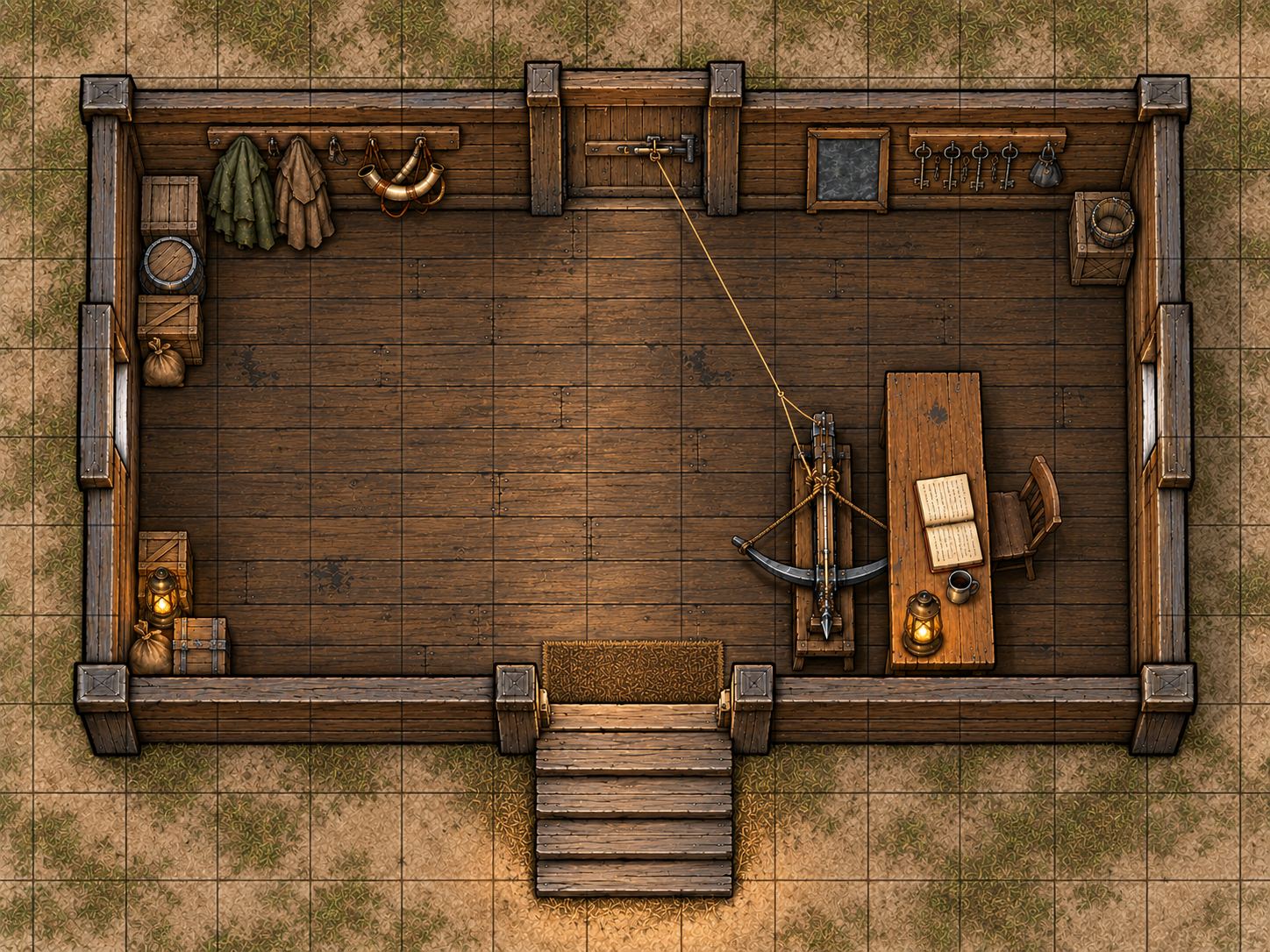
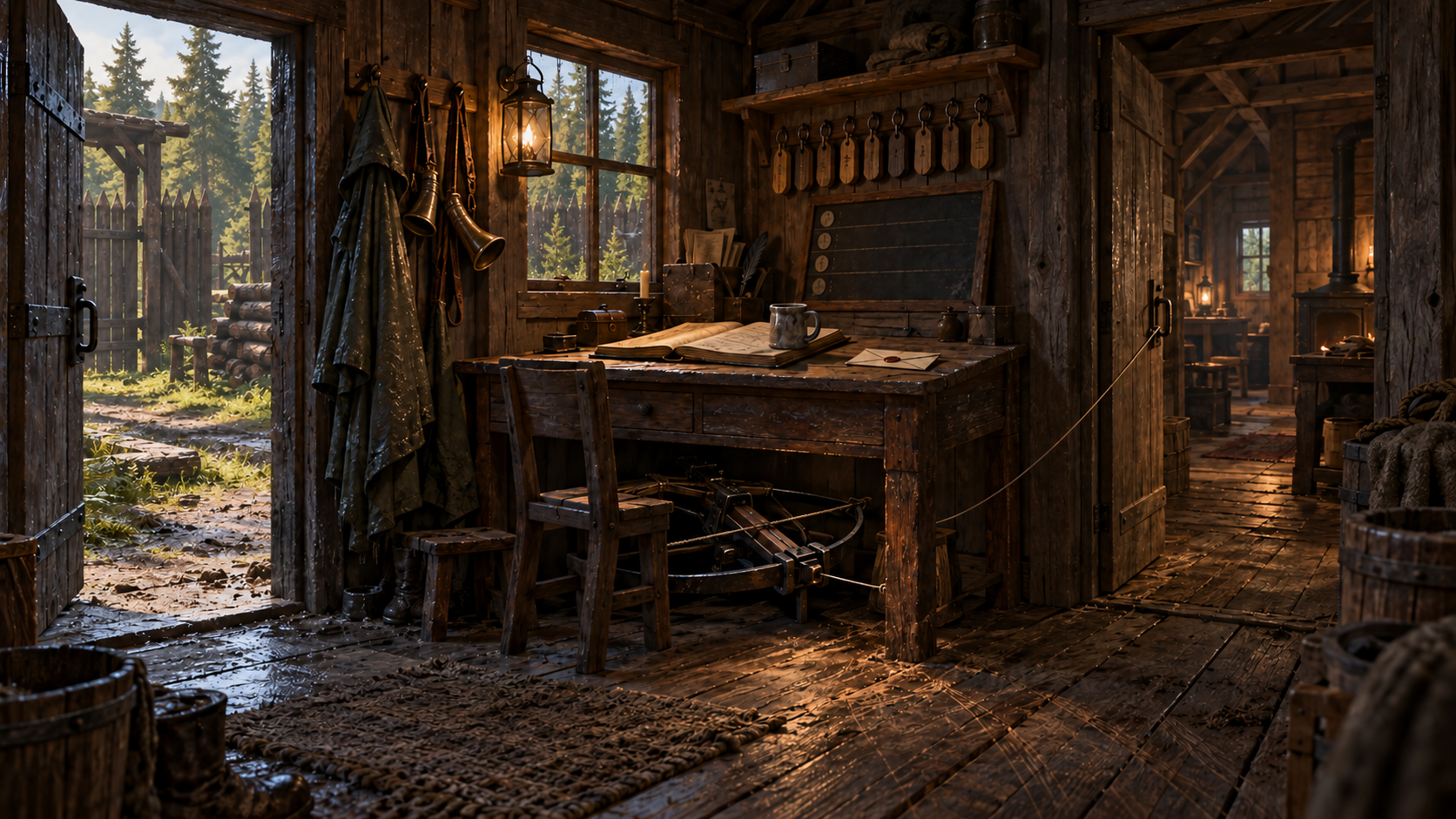
The small gatehouse smells of cold lamp oil, damp wool, and old paper.
Pegs beside the outer door still hold rain cloaks and signal horns.
A narrow duty desk faces the gate, its open ledger weighted down by a chipped stone mug.
A ring of numbered wooden key tags hangs from hooks beside the desk.
Beneath them, a slate duty board still carries the names of the final watch rotation.
Nothing here looks packed away. It looks as though the guards expected to return to their posts.
The room is less orderly near the doorway leading deeper into the camp.
The desk has been dragged slightly out of position, leaving fresh scratches across the floorboards.
Beneath it, something bulky has been wedged into the shadows.
A thin length of cord disappears from beneath the desk toward the latch of the interior door.
Beside the open ledger lies a folded sheet of paper, left in plain view rather than filed with the gate records.
A hurried hand covers most of the page.
The gatehouse handled visitors, keys, wagon entries, shift changes, and basic security.
Its ordinary records are useful precisely because they are mundane: Reiver's Right was still receiving supplies,
logging crews, and routine freight shortly before the camp went silent.
The gatehouse also preserves evidence of the final breakdown inside the camp.
Someone hurriedly converted a heavy crossbow into an improvised trap aimed across the room,
and someone left behind a written account of Hendrick's disappearance and the workers' decision to flee.
A heavy crossbow has been lashed beneath the duty desk and aimed toward the interior doorway.
A thin signal cord runs from the crossbow's trigger to the door latch.
Opening the door pulls the cord and fires the weapon at approximately chest height.
The mechanism is crude, recent, and obviously improvised from equipment already inside the gatehouse.
It is not part of Reiver's Right's permanent defenses.
Characters who inspect the room before opening the interior door can notice the disturbed desk,
fresh floor scratches, the concealed bulk beneath it, or the thin trigger cord.
Resolve detection and disabling using the separate Gatehouse Snapbow hazard.
The trap should suggest panic rather than military preparation.
Someone inside Reiver's Right expected another person or creature to follow through this doorway
and wanted to injure or delay the pursuer.
No check is required to establish the basic timeline.
Wagon traffic, visitor entries, guard rotations, and supply deliveries continue normally until approximately
four days ago. The records then stop abruptly.
Nothing in the final entries resembles preparation for a closure or evacuation.
There are no orders to dismiss crews, transfer stores, release draft animals,
secure valuables, or send workers back toward Macridi.
Characters who already established the four-day timeline at the South Gate immediately recognize
that the gatehouse records support the same conclusion.
Challenge 1: Cross-Check the Gate Ledger
The gate ledger records wagon arrivals, visitors, workers temporarily leaving the camp,
and other routine movement through the south entrance.
Comparing those entries with the duty roster reveals several discrepancies in the camp's final hours.
Primary Check
Society DC 15, Perception DC 16, or Mercantile Lore DC 14
Critical Success
Several workers who should have been away from Reiver's Right are still listed as present,
and no corresponding departure exists for them.
At the same time, the last heavy wagon entries look entirely routine.
Clue: The workforce did not leave through the main gate,
and normal commercial activity continued almost until communication stopped.
Success
The character notices that several workers remain listed as present even though
the records contain no later departure for them.
Clue: The gatehouse ledger cannot account for many of the missing workers leaving Reiver's Right.
Failure
The ledgers contain too many routine entries to reconstruct individual worker movements with confidence.
The character confirms only that ordinary camp traffic continued until shortly before the records stopped.
Critical Failure
The character confuses several arrival and departure marks and cannot establish a reliable pattern.
Later evidence elsewhere in the camp can correct the misunderstanding without penalty.
Challenge 2: Reconstruct the Final Watch
The duty slate and guard notes provide a more immediate picture of what was happening inside the camp
during the final watch. Most entries are routine: gate checks, wagon inspections, key transfers,
and reports from other posts.
Primary Check
Perception DC 15, Society DC 16, or Warfare Lore DC 14
Critical Success
The character finds the final unfinished guard entry:
"Second ground tremor. Foreman says restrict nonessential traffic until—"
The sentence ends halfway across the page.
Clue: Something unusual was already occurring beneath or around the camp
immediately before the gatehouse was abandoned, and camp leadership had begun restricting movement.
Success
The final watch records mention a second ground tremor
and an instruction to restrict nonessential traffic.
No emergency evacuation order follows.
Clue: The camp was reacting to an internal disturbance,
not preparing for an outside attack.
Failure
The final notes are hurried and incomplete.
The character can tell the guards were responding to some unusual condition
but cannot determine what prompted it.
Critical Failure
The character mistakes several routine gate restrictions for emergency measures
and cannot determine which entries were significant.
Challenge 3: Account for the Gatehouse Keys
Numbered tags identify keys for the gate, storehouse, smithy, stables,
foreman's hall, and several other camp buildings. Most remain on their hooks.
Primary Check
Perception DC 15 or Society DC 16
Critical Success
One numbered hook is empty, but its identifying label has been scraped away recently.
The remaining sequence shows that the missing key was deliberately removed from the normal inventory
rather than simply misplaced.
Clue: Someone wanted access to a location that the ordinary gatehouse records no longer identify.
Success
One key is missing from the otherwise orderly rack,
and its tag appears to have been removed deliberately rather than falling loose.
Failure
The character notices that the key rack is incomplete
but cannot determine whether the missing key is significant or simply in use elsewhere.
Critical Failure
The numbered system is unfamiliar enough that the character cannot confidently determine
whether any keys are missing.
The folded page beside the ledger is not part of the official gatehouse records.
It was left deliberately where someone entering the abandoned camp would be likely to find it.
The handwriting is hurried but readable.
Hendrick is gone. He put a piece of that black root-growth in his chest pocket,
and by evening it had eaten through the cloth and embedded itself in his skin.
We tried to cut it out. He stopped us and said he liked it like that.
After that he started acting strange, listening to things nobody else could hear.
Sometime before dawn he disappeared.
There are fifty of us leaving.
A few others are still unaccounted for, but nobody wants to stay here long enough
to find out where they went.
We're splitting into two groups.
One will make for the Cedar Court and the other for the Court of Endless Revelry.
Nobody wants to use the North Road.
We've heard the blight is worse at the crossroads near the Pulgari Estate,
and we're not waiting around to learn whether the rumors are true.
The letter provides the first direct explanation for why most of the workforce is absent.
The workers did not disappear as a single group and they did not evacuate through the main gate.
They fled Reiver's Right overland in two groups after Hendrick disappeared.
The letter also confirms that several people were already missing before the evacuation,
meaning that the fifty refugees do not account for everyone assigned to Reiver's Right.
The reference to the Pulgari Estate should function as a warning and future lead,
not as proof that the rumors about the crossroads are accurate.
The writer only knew what frightened workers had heard before leaving.
The Gatehouse reinforces the timeline established at the South Gate
and adds the first strong evidence that the crisis unfolded inside Reiver's Right.
The camp remained commercially active until shortly before the silence,
and the final watch was reacting to ground tremors rather than an outside assault.
The improvised snapbow shows that the final occupants feared something following them
through the camp. It should feel like a desperate last-minute measure,
not part of an organized defense.
The letter establishes what happened to most of the workforce:
fifty workers fled in two groups,
one toward the Cedar Court and one toward the Court of Endless Revelry,
while deliberately avoiding the North Road near the Pulgari Estate.
It also establishes that Hendrick's corruption had become visible before his disappearance
and that a few workers were already unaccounted for when the evacuation began.
The missing key should remain unexplained here.
It can later connect to the concealed hoist, restricted work area,
or another access point associated with the excavation.