Infernal Treeling
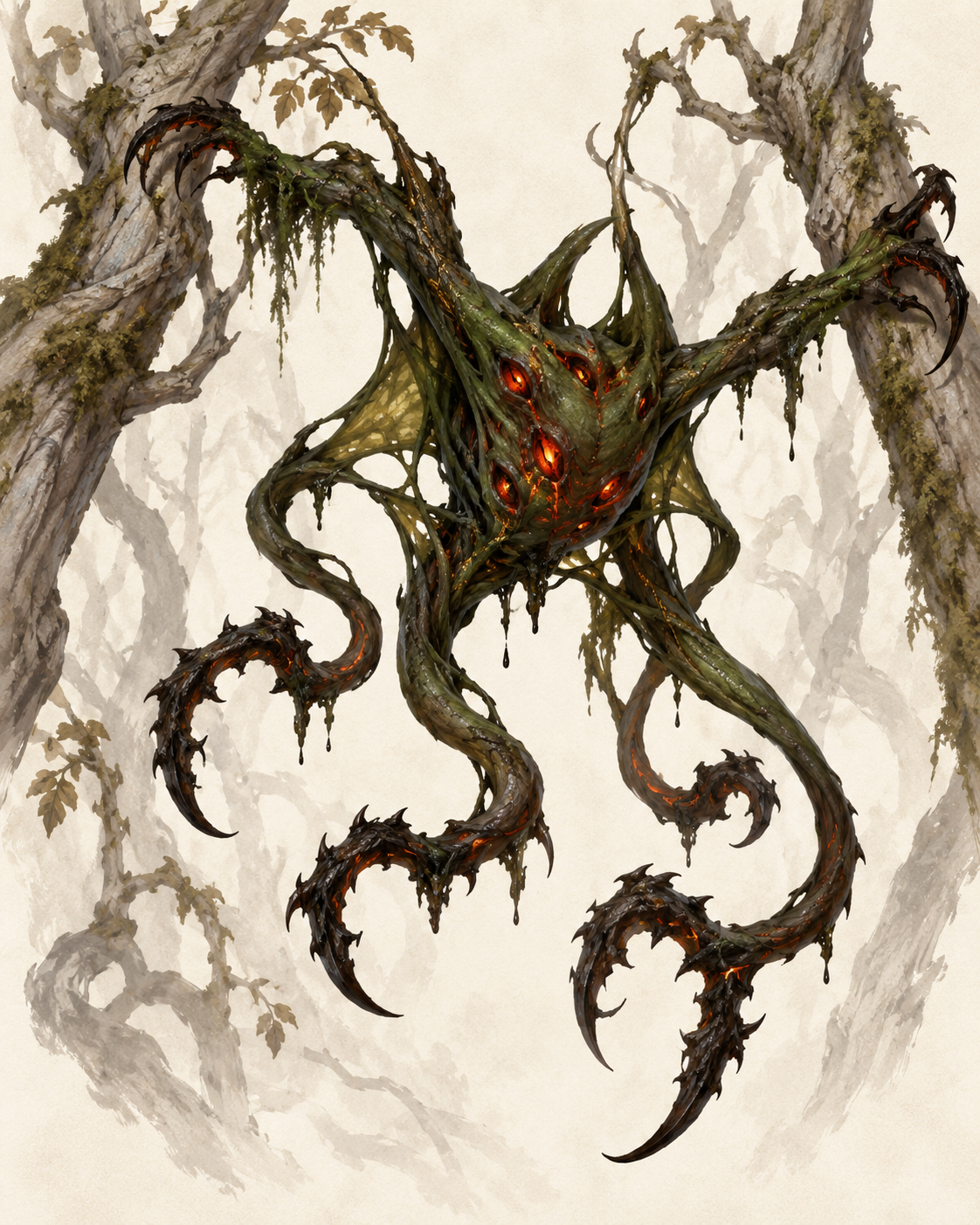
INFERNAL TREELING CREATURE 2
[UNCOMMON] [MEDIUM] [FIEND] [PLANT]
Infernal treelings are arboreal offshoots of the corruption spreading beneath the Palakar Forest. Their bodies are built from twisted roots, scorched bark, hooked limbs, and long tendrils slick with oily black sap. Dull ember-light glows through cracks in their wooden flesh.
Treelings spend most of their time above the forest floor. They hang beneath heavy branches, flatten themselves against trunks, or swing between neighboring trees using their hooked tendrils. When prey passes below, a treeling drops suddenly from the canopy, drives a hollow thorn into its victim, injects corrupting black sap, and then races back up the nearest trunk before its prey can surround it.
On the ground, treelings move in a low, rapid scamper using their arms, legs, and trailing roots together. They remain fast, but their awkward ground posture leaves them less capable of defending themselves or striking accurately. Forcing a treeling out of the canopy is a significant tactical advantage.
Perception +8; darkvision
Languages understands Infernal and Fey but can't speak
Skills Athletics +9, Stealth +7 (+9 in forests), Survival +8
Str +4, Dex +2, Con +3, Int –2, Wis +2, Cha +0
AC 17; 18 while benefiting from Canopy Predator
Fort +9, Ref +6, Will +8
HP 36
Resistances fire 3
Weaknesses vitality 3
Speed 30 feet, climb 25 feet
Melee ◆ claw +10 (+11 while benefiting from Canopy Predator), Damage 1d8+4 slashing
Melee ◆ tendril +10 (+11 while benefiting from Canopy Predator) (reach 10 feet), Damage 1d6+4 bludgeoning
SPECIAL ABILITIES
Canopy Predator
An infernal treeling is adapted to fight while hanging from trunks, branches, exposed roots, heavy vines, and similar vegetation.
While the treeling is at least 5 feet above the ground and supported by a tree, substantial branch, hanging root, vine, or similar vegetation, it gains a +1 circumstance bonus to AC and attack rolls.
These bonuses are already included in the parenthetical values above.
A treeling on the ground loses these bonuses. Its ground movement remains fast, but it must use several of its limbs and tendrils for locomotion, making it easier to hit and reducing the precision of its attacks.
Canopy Swing ◆ [move]
Requirements The treeling is supported by a tree, branch, hanging root, vine, or similar vegetation.
The treeling releases its current perch and swings, climbs, or launches itself through the canopy. It moves up to 25 feet.
During this movement, the treeling can cross open gaps of up to 10 feet between suitable branches or trees, provided it ends the movement supported by another tree, branch, root, vine, or similar surface.
This movement uses the treeling's climb Speed and does not require an Athletics check.
Drop and Inject ◆◆ [move] [poison]
Requirements The treeling is clinging to a tree, branch, hanging root, or similar vegetation at least 10 feet above the ground, and a creature is within 20 feet below it.
The treeling abruptly releases its perch and drops toward its prey, unfolding its limbs and hooked tendrils only moments before impact.
The treeling drops up to 20 feet and lands in an unoccupied space adjacent to the target. It takes no falling damage and does not fall prone from this controlled descent.
The treeling then makes a claw Strike against the target.
On a hit, the treeling drives a hollow thorn through the wound and injects a pulse of hot black sap. The target must attempt a DC 18 Fortitude save against Infernal Sap Venom.
The claw Strike made as part of Drop and Inject counts toward the treeling's multiple attack penalty normally.
Infernal Sap Venom [curse] [poison] [primal]
The treeling's black sap carries the same lignifying corruption that runs through the larger blight. Once injected beneath the skin, it briefly converts living tissue into stiff woody fibers.
Saving Throw DC 18 Fortitude
Critical Success The creature is unaffected.
Success The creature's muscles briefly stiffen. It takes a –5-foot status penalty to its Speeds until the start of its next turn.
Failure Black veins spread from the wound and woody fibers begin forming beneath the skin. The creature takes a –5-foot status penalty to its Speeds and is clumsy 1 until the end of its next turn.
Critical Failure The corruption spreads rapidly through the affected limb. The creature takes a –10-foot status penalty to its Speeds and is clumsy 1 for 1 minute.
At the end of each of its turns, a creature suffering the critical failure effect can attempt another DC 18 Fortitude save, ending the effect on a success.
The black veins and woody growth recede when the effect ends.
Scamper Up ◆ [move]
Requirements The treeling is on the ground and adjacent to a tree, substantial exposed root, wooden support, or similarly climbable surface.
The treeling collapses into a low, spiderlike posture and races onto the surface, hooking its claws and tendrils into the wood.
It Climbs up to its 25-foot climb Speed.
If it ends this movement at least 5 feet above the ground, it again benefits from Canopy Predator.
Hellroot Eruption ◆◆ [fire] [primal]
Frequency once per 1d4 rounds
The treeling drives one or more tendrils into the ground or into the trunk of a living tree, sending infernal corruption racing through the surrounding roots.
Burning black roots erupt in a 10-foot burst within 30 feet.
If the treeling is in a tree, the burst must originate on the ground within 30 feet of that tree.
Creatures in the area attempt a DC 18 Reflex save.
Critical Success No damage.
Success Half damage.
Failure 1d6 piercing plus 1d6 fire damage.
Critical Failure Double damage and the creature falls prone.
The affected squares become difficult terrain until the start of the treeling's next turn.
Black Sap Reprisal ↻ [fire]
Trigger A creature within 5 feet deals slashing or piercing damage to the treeling.
Effect A pressurized pocket of black sap bursts from the wound. The triggering creature must attempt a DC 17 Reflex save.
Critical Success The creature is unaffected.
Success The creature takes 1 fire damage.
Failure The creature takes 1d4 fire damage.
Critical Failure The creature takes 1d4 fire damage and is dazzled until the end of its next turn as smoking sap splashes across its face.
TACTICS
Infernal treelings strongly prefer to remain above their prey. Before combat, they hang beneath branches, cling against trunks, or crouch among overlapping limbs where their dark bark blends into the surrounding forest.
They use Canopy Swing to follow creatures from tree to tree, rarely touching the forest floor unless attacking.
Their preferred attack routine is Drop and Inject followed immediately by Scamper Up.
This consumes all three of the treeling's actions. The creature drops onto a target, makes a single claw Strike, attempts to inject its corrupting venom, and then races back up the trunk before nearby enemies can surround it.
A treeling normally chooses targets standing near trees so that it can retreat immediately after attacking. It is reluctant to drop into open clearings unless ordered or desperate.
If several creatures cluster together beneath the canopy, the treeling may instead remain elevated and use Hellroot Eruption to break up their formation.
On the ground, a treeling drops into a fast, low gait and scampers on its legs, hooked hands, and trailing roots. Its 30-foot Speed makes it difficult to corner, but it loses Canopy Predator, reducing its AC and attack accuracy until it reaches elevated vegetation again.
Treelings show an unnatural preference for attacking fey, animals, and creatures using primal magic.
TACTICAL COUNTERPLAY
Bringing a treeling out of the canopy is intended to materially weaken it.
Characters can gain an advantage by knocking it from a branch, Shoving it away from a trunk, immobilizing it, moving into an open clearing, blocking access to nearby trees, or otherwise preventing it from using Scamper Up.
A treeling deliberately using Drop and Inject can control its fall and lands safely. A treeling that is instead knocked or forced from its perch uses the normal rules for falling and can take falling damage and land prone as appropriate.
GM NOTES
Role: Arboreal ambusher / hit-and-run skirmisher.
Canopy profile: AC 18; claw and tendril attacks +11.
Ground profile: AC 17; claw and tendril attacks +10.
The difference is intentional. Once the party prevents the treeling from returning to the canopy, the encounter should become noticeably easier.
Preferred turn: Drop and Inject ◆◆ → Scamper Up ◆.
Story clue: When slain, the treeling's roots contain tiny veins of gold-colored mineral growth mixed with its black sap. The deposits suggest that the forest corruption is absorbing and incorporating infernal material as the creature develops.