B2 — The Keep on the Borderlands
Original B2 content in HTML; edition conversion and balance pending · Original B2: 1–3; conversion balance pending · The Borderlands — the Keep and Caves of Chaos
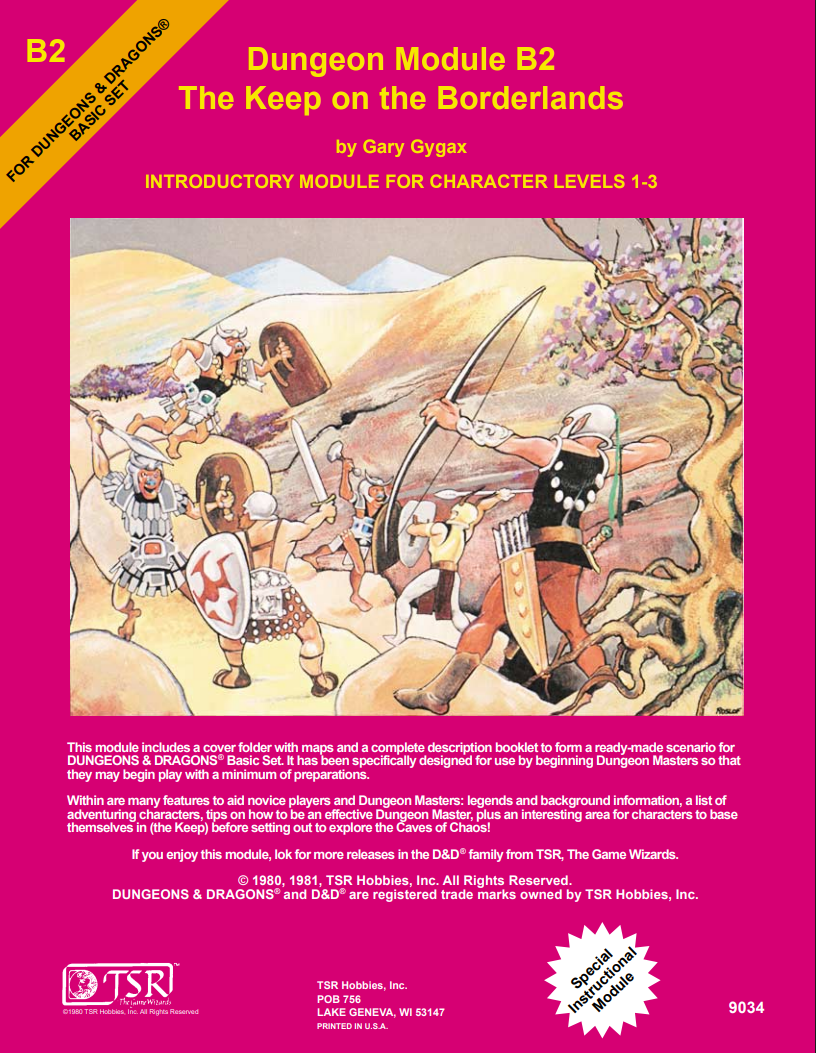
The Keep on the Borderlands
Content pass from the supplied B2 PDF. Source descriptions, statistics, treasure, traps and GM advice are stored in built-in HTML narratives. Statistics are the original Basic D&D values, not a completed D&D 3.5 or Pathfinder conversion. Balance remains unassessed.
Introduction and Guidance for the Dungeon Master
Introduction: Welcome to the land of imagination. You are about to begin a journey into worlds where magic and monsters are the order of the day, where law and chaos are forever at odds, where adventure and heroism are the meat and drink of all who would seek their fortunes in uncommon pursuits. This is the realm of DUNGEONS & DRAGONS@ Adventure Game.
If you plan to play in this module and participate in the fun of adventuring, stop reading now. The information in the rest of the module is for your Dungeon Master or DM, so that he or she may guide you and other players through a thrilling adventure. Knowing too much about the contents of this module will spoil the surprises and excitement of the game.
Dungeon Masters, if many copies of this module are available to the players, you may wish to alter sections of the Keep and the Caves of Chaos. If you do this, you will be sure to have new surprises for players who might be familiar with some of the contents of the module. You are not entering this world in the usual manner, for you are setting forth to be a Dungeon Master. Certainly there are stout fighters, mighty magic-users, wily thieves, and courageous clerics who will make their mark in the magical lands of D&D@ adventure. You, however, are above even the greatest of these, for as DM you are to become the Shaper of the Cosmos. It is you who will give form and content to all the universe. You will breathe life into the stillness, giving meaning and purpose to all the actions which are to follow. The others in your group will assume the roles of individuals and play their parts, but each can only perform within the bounds you will set. It is now up to you to create a magical realm filled with danger, mystery, and excitement, complete with countless challenges. Though your role is the greatest, it is also the most difficult. You must now prepare to become all things to all people.
Notes For The Dungeon Master
The basic instruction book for DUNGEONS & DRAGONS@ Game has given you the information necessary to understand this game and start play. This module is another tool. It is a scenario or setting which will help you to understand the fine art of being a Dungeon Master as you introduce your group of players to your own fantasy world, your interpretation of the many worlds of DUNGEONS & DRAGONS@ Adventure. THE KEEP ON THE BORDERLANDS is simply offered for your use as a way to move smoothly and rapidly into your own special continuing adventures or campaigns. Read the module thoroughly; you will notice that the details are left in your hands. This allows you to personalize the scenario, and suit it to what you and your players will find most enjoyable. NOTE: Several words in the following text will be followed by an asterisk (*). This means that the word will be explained in the Glossary at the end of this module.
This module has been designed to allow six to nine player characters of first level to play out many adventures, gradually working up to second or third level of experience in the process. The group is assumed to have at least one magic-user and one cleric In It. If you have fewer than six players, be sure to arrange for them to get both advice and help in the KEEP. For example, they should have advice from a friendly individual to “stay near the beginning of the ravine area, and enter the lower caves first”, to avoid their getting into immediate trouble with higher level monsters. Likewise, the services of several men-at-arms must be available to smaller parties, If only two or three player characters are to adventure, be sure to have a non-player character or two go along, as well as a few men-at-arms. In addition, give the player characters a magic dagger or some magic arrows and at least one potion of healing - family bequests to aid them in finding their fame and fortune when they go against Chaos.
The DM should be careful to give the player characters a reasonable chance to survive. If your players tend to be rash and unthinking, it might be better to allow them to have a few men-at-arms accompany them even if the party is large, and they don’t attempt to hire such mercenaries. Hopefully, they will quickly learn that the monsters here will work together and attack intelligently, if able. If this lesson is not learned, all that can be done is to allow the chips to fall where they may. Dead characters cannot be brought back to life here! Using the KEEP as “home base”, your players should be able to have quite a number of adventures (playing sessions) before they have exhausted all the possibilities of the Caves of Chaos map. Assuming that they have played well, their player characters will certainly have advanced a level or two in experience when the last minion of darkness falls before their might. While your players will have advanced in their understanding and ability, you will likewise have increased your skills as DM. In fact, before they have finished all the adventure areas of this module, it is likely that you will have begun to add your own separate maps to the setting. The KEEP is only a small section of the world. You must build the towns and terrain which surround it. You must shape the societies, create the kingdoms, and populate the countryside with men and monsters.
The KEEP is a microcosm, a world in miniature. Within its walls your players will find what is basically a small village with a social order, and will meet opponents of a sort. Outside lies the way to the Caves of Chaos where monsters abound. As you build the campaign setting, you can use this module as a guide. Humankind and its allies have established strongholds - whether fortresses or organized countries - where the players’ characters will base themselves, interact with the society, and occasionally encounter foes of one sort or another. Surrounding these strongholds are lands which may be hostile to the bold adventurers. Perhaps there are areas of wilderness filled with dangerous creatures, or maybe the neighboring area is a land where chaos and evil rule (for wilderness adventures, see DUNGEONS & DRAGONS@ EXPERT SET). There are natural obstacles to consider, such as mountains, marshes, deserts, and seas. There can also be magical barriers, protections, and portals. Anything you can imagine could be part of your world if you so desire. The challenge to your imagination is to make a world which will bring the ultimate in fabulous and fantastic adventure to your players. A world which they may believe in.
NOTE: For your convenience, whenever a monster or nonplayer character (NPC) is described in the text, the details will be listed in the following order:
Name (Armor Class, Class/Level or Hit Dice, hit points, Number of Attacks per round, Damage per attack, Movement (per round), Save as class and level, Morale) Armor Class = AC; Class: Cleric = C, Fighter = F, Magicuser = M, Thief = T, Dwarf = D, Elf = E, Halfling = H, Normal Man = LVL 0 or NM; Level = #, Hit Dice = HD, hit points = hp, Number of Attacks =#AT, Damage = D, Movement = MV, Save = Save, Morale = ML.
Class/level is only used for non-player characters (NPCs), while Hit Dice is used for all other monsters. Movement in a game turn is three times the movement given for one combat round. NPCs save at the same level as their class level of experience. Examples: Taverner [statistics 1] Guard [statistics 2] Kobold [statistics 3]
Original B2 statistics 1
AC 9, LVL 0, hp 6, #AT 1, D 1-6, ML 8
Original B2 statistics 2
AC 4, F 1, hp 7, #AT 1, D 1-6, ML 10
Original B2 statistics 3
AC 7, HD V2, hp 3, #AT 1, D 1-4, MV (40’) Save NM, ML 6
#AT 1/2 indicates that the player may only attack once every 2 rounds.
An asterisk after Hit Dice indicates an experience point l bonus. * * Two asterisks after Hit Dice indicates double the normal experience point bonus.
Determining Armor Class:
Armor Class Type of Armor 9 None Shield only; Leather Leather&Shield : Chainmail 4 Chainmail &Shield Plate Mail i Plate Mail &Shield 1 Plate Mail & magic Shield +1 (or other combinations)
Note that an Armor Class (AC) of less than 2 is possible for characters wearing magic armor, carrying a magic shield, having a higher than normal Dexterity score, and/or wearing a ring of protection. Players using these items will subtract bonuses from their AC - for example, a fighter using both Plate Mail + 1 and Shield + 1 would have AC 0.
Using the Combat Tables:
To find the die roll needed to hit any Armor Class, look at the HOW TO ATTACK section in the D&D Basic Set rulebook. Compare the Level (if a character) or Hit Dice (if a monster) with the AC of the target to find the number needed ‘to hit’. For Armor Classes lower than 2, adjust the number upwards; a character needing a roll of 17 to hit AC 2 would need an 18 to hit AC I, 19 to hit AC 0, and so forth. Unless magic or silver weapons are needed to cause damage (and not available), a roll of 20 will always hit, and a roll of 1 will always miss!
A bonus of +1 should be added to the “to hit” die roll of high level characters, for they have more training and experience in fighting. This bonus will apply to Fighters of 4th level or above, to Clerics and Thieves of 5th level or above, and to Magic-Users of 6th level or above.
Movement in Combat:
Combat movement is usually very short and quick. In a combat situation, only short charges or retreats are allowed. After combat is resolved, movement rates return to normal. The movement speed for characters is:
Unarmored, unencumbered man: 40 feet per melee round Metal armored or encumbered man: 20 feet per melee round Metal armored, encumbered man: 10 feet per melee round
To determine a monster’s movement speed in combat, divide its base movement speed by 3. Note: Movement speed may be different if the optional encumbrance rule is used. When dice are used to randomly determine a number, the type of dice used are abbreviated ‘d#’ (‘d4’ means a foursided die, ‘d6’ a six-sided, and so forth). If more than one is rolled, the number required is placed before the ‘d’ (‘2d6’ means two six-sided dice). If any number is to be added to the total of the dice, it is indicated afterward (‘d4 + 2’ means to roll a four-sided die and add 2 to the total: ‘2d8 + 1’ will thus give a number from 3 to 17). You will quickly get to know all of these abbreviations, and may use them when you design your own dungeon.
Become familiar with this module, then make whatever additions or changes you feel are necessary for your campaign. Once you are satisfied, gather the players together and have them create their characters. This will take some time, so at first, don’t plan on getting much playing done unless there is a lot of time available. After each person has rolled the numbers for his or her characteristics (Strength, Intelligence, etc.), selected a class, and found how much money he or she has to begin, you should introduce them to the setting by reading the Background section to them. If you wish, feel free to limit the classes your players may choose as suits your setting. You might wish not to have elves or halflings in the KEEP, or you might not want any thieves as beginning characters. It is all up to you as DM to decide the shape of the campaign. Likewise, you can opt to give the player characters a special item of equipment to begin with - possibly mules, a weapon, some trade goods, or virtually anything of small value (within reason).
After you have explained the background, allow your players to begin interacting with their characters. Give them time to wander around the KEEP, learning what is there, finding the limits of their freedom, and meeting the other “inhabitants” of the place. They may quickly establish their base in the Traveler’s Inn, purchase their equipment, and then visit the tavern - where they may gather bits of information for their coming adventures. All of this play, as well as what will come afterwards, requires that the players play the personae (personalities) of the characters that they will have throughout the length of the campaign, much like an actor plays a role in a play. You, however, have a far greater challenge and obligation! You not only must order and create the world, you must also play the part of each and every creature that the player characters encounter. You must be gate guard and merchant, innkeeper and orc oracle and madman as the situation dictates. The role of DM is all-powerful, but it also makes many demands. It is difficult to properly play the village idiot at one moment and the wise man the next, the noble clergyman on one hand and the vile monster on the other. In one role you must be cooperative, in the next uncaring and non-commital, then foolish, then clever, and so on. Be prepared!
Whether the first time you play or the next, the players will set forth to find and explore the many Caves of Chaos. You must describe the journey to the place and what the characters see, and allow them to choose how they will go about their adventuring. In such situations, the DM must be a truly disinterested party, giving information as required by questioning and proper action, but neither helping nor hindering otherwise. When the players experience their first encounter with a monster, you must be ready to play the part fully. If the monster is basically unintelligent, you must have it act accordingly. Make the encounter exciting with the proper dramatics of the animal sort - including noises! If the encounter is with an intelligent monster, it is up to the DM to not only provide an exciting description but also to correctly act the part of the monster. Rats, for instance, will swarm chitteringly from their burrows - a wave of liceridden hunger seeking to overrun the adventurers with sheer numbers, but easily driven off squealing with blows and fire. Goblins, on the other hand, will skulk and hide in order to ambush and trap the party - fleeing from more powerful foes, but always ready to set a new snare for the unwary character.
If all of this seems too difficult, never fear! Just as your players are learning and gaining experience at D&D@ play, so too will you be improving your ability as a DM. The work necessary to become a master at the art is great, far greater than that necessary to be a top player, but the rewards are even greater. You will bring untold enjoyment to many players in your role as DM, and all the while you will have the opportunity to exercise your imagination and creative ability to the fullest. May each of your dungeon adventure episodes always be a wondrous experience!
How To Be An Effective Dungeon Master
As Dungeon Master, the beginner is faced with a difficult problem. The DM is the most important person in the D&D@ game. He or she sets up and controls all situations, makes decisions, and acts as the link between the players and the world he or she has created. Perhaps the most common question asked by a beginning Dungeon Master is, “What do I do to run a game?” It is possible to read through the rules and become slightly lost by all the things that must be prepared or known before DMing a game.
Unlike most boardgames, D&D play relies on information, both from the players and the DM. In boardgames, the way the game is played is obvious. First one person moves, and then another. Actions are limited and choices are few. In this game, the action is only limited by the abilities of the character, the imagination of the player, and the decisions of the DM. The play will often go in unexpected directions and the DM will sometimes be required to decide on situations not covered in the rules. The DM is the judge.
As a judge, moderator, or referee, the DM must constantly deal with the players. Just as the referee of a sporting event, the DM must be fair. He or she cannot be “out to get the players”, nor should he or she be on their side all the time. The DM must be neutral. If a party has played well and succeeded, the DM should not punish them by sending more and more monsters at them or thwart their plans; on the other hand, if the players have acted foolishly, they should get their “just rewards”. In combat, the DM should play the monsters to the best of the monster’s ability. If the creature is stupid, it may be easily tricked or may not always do the smartest thing. If the monster is clever or intelligent, it will fight to its best advantage. The DM must be fair, but the players must play wisely.
The DM is also the designer of the situations and must bear in mind the abilities of his or her players. It is the job of the DM to see that the situations and characters balance. If things are too difficult, the players will become discouraged; too easy and they will become bored. Is it possible for a good player to win, yet still be a challenge and a risk in doing so? Is the amount of treasure gained equal to the danger of trying to get it? As DM, much satisfaction comes from watching players overcome a difficult situation. But they should do it on their own!
To defeat monsters and overcome problems, the DM must be a dispenser of information. Again, he or she must be fair - telling the party what it can see, but not what it cannot. Questions will be asked by players, either of the DM or of some character the party has encountered, and the DM must decide what to say. Information should never be given away that the characters have not found out secret doors may be missed, treasure or magic items overlooked, or the wrong question asked of a townsperson. The players must be allowed to make their own choices. Therefore, it is important that the DM give accurate information, but the choice of action is the players’ decision.
Throughout all this - making decisions, playing roles, handling monsters - the DM must remember that he or she is in control. The DM is the judge, and it is his or her game./ The DM should listen to the players and weigh their arguments fairly when disagreements arise, but the final decision belongs to the DM. The Dungeon Master’s word is law!
Time
The Dungeon Master is responsible for keeping a track of game time. Inside the dungeon, a normal turn is ten minutes long (adventure time). A normal turn is determined by the distance the slowest party member can travel, using the CHARACTER MOVEMENT TABLE in the Dungeons & Dragons Basic Set rulebook. For example, a party whose slowest member moves at 120feet per turn, would travel 120 feet in a turn. When the party has mapped 120 feet of dungeon, one turn has passed. lf fighting should occur, the time reference shifts to melee rounds of 10 seconds each. Melee rounds are used to simulate the quick exchange of blows in combat. For convenience, a DM should consider one entire melee to last long as one normal turn (that is, 10 minutes), no matter how many melee rounds the combat actually took. The extra time is spent recovering one’s breath, bandaging wounds, resharpening blunted weapons, etc. The actual (clock-time) length of a turn varies. A turn might take longer than ten actual minutes, especially if a long combat has taken place. On the other hand, a turn may be quite short in actual time, if the party is heading back through a familiar area.
In general, a party should rest and sleep eight hours every 24. Cautious player characters will sleep in shifts, with a guard always awake.
Remember that player characters heal 1-3 points naturally every 24 hours of full rest.
Dividing Treasure And Computing Experience
After the party leaves the dungeon safely, all surviving player characters should divide the treasure and be awarded their experience points. Division of treasure is the players’ responsibility. Awarding experience points is the Dungeon Master’s responsibility.
Ideally, treasure should be divided equally among surviving player characters, with retainers usually receiving a share (minus any advance payment already given them). Players may decide to only give magical items to character classes that could use them. For example, a fighter should take a magical sword as part of his or her share in preference to a scroll.
Non-magical treasure is usually divided first, since it is easier to divide equally. It is seldom possible to divide magic items equally. A suggested solution to division of magic items is to have each character roll percentile dice and let the highest score have first pick, second highest score second pick, and so on until there are no more magical items. Retainers may, or may not, be given an equal chance for a magic item. If they are excluded, a DM should note the fact and take it into account when it next comes time to test the retainers’ loyalty.
For example, a party consisting of a fighter, a magic-user, and a retainer (all first level) returns safely to the Keep. Their recovered treasure equals 520 gold pieces, 1000 silver pieces, a necklace worth 400 gold pieces, a sword +I and a ring of water walking. The total value of all non-magical treasure is 1020 gold pieces. Without selling the necklace, it would be impossible for the party to split the treasure equally. The two player characters compromise by giving the necklace to their retainer, to insure his loyalty with a greater share of treasure. They each take only 310 gold pieces, but the magic-user keeps the ring and the fighter keeps the sword.
Experience points are awarded by the DM to player characters on the basis of non-magical treasure recovered and monsters killed or overcome. Experience points for recovered treasure are calculated at one experience point for every gold piece worth of non-magical treasure. Experience points for monsters overcome or killed is calculated by using the Experience Points for Monsters chart in the DUNGEONS & DRAGONS Basic Set rulebook.
Unless a player character has earned extra treasure through the use of his or her class abilities (for example, a thief who steals treasure which he did not report to the party), the DM should divide the experience points earned through treasure recovery equally among all surviving party members. Since, in the above example, the entire party recovered 1020 gold pieces worth of nonmagical treasure, the fighter and the magic-user each receive 340 experience points for the treasure recovered. The retainer receives 1/2 normal experience, since he was only following orders, and not doing his own thinking. The retainer thus receives only 170 experience points for recovered treasure.
To recover the treasure, it was necessary for the party members to kill 19 orcs, 7 skeletons, and an ogre. The party should receive 10 points of experience for each orc killed, as orcs have 1 hit die. The party should receive 5 experience points for each skeleton. For killing the ogre, they should receive 125 experience points, since it has 4 + 1 hit dice. The total experience points for defeating monsters would be 350. When this is divided, the magic-user and fighter each receive 117 additional experience points. The retainer receives only one-half, 59 additional experience points. The total experience for each player character is 457 (340 + 117) experience points apiece. The retainer receives 229 experience points.
When enough experience points are accumulated, a player character rises to the next higher level, and gains the benefits of that level (an additional hit die, a new spell, etc.). Wealth can be used to buy new equipment, to pay for everyday expenses, and to hire retainers.
Preparation For The Use Of The Module
The use of this module first requires that the DM be familiar with its contents. Therefore, the first step is to completely read through the module, referring to the maps provided to learn the locations of the various features. A second (and third!) reading will be helpful in learning the nature of the monsters, their methods of attack and defense, and the treasures guarded.
Certain buildings of the KEEP will frequently be visited by the adventurers (such as the Travelers Inn, Tavern, and Provisioner). Floor plans are very useful in visualizing these areas. For information on their preparation, refer to the section entitled “Designing Floor Plans” near the end of the module.
Once you are familiar with the areas described in the module and have drawn whatever additional plans you wish, assist the players in preparing their characters by reading them the section entitled Background. This will set the stage for the game.
After the background is given, the players may prepare their characters. Full details are given in the D&D BASIC SET rulebook. A written record of each character should be kept by the players.
As an alternative to rolling up new characters, the players may (at the DM’s option) select characters from the NPC list in this module. Note that the personalities given are for the DM’s use with NPC’s only, and are not to be used by the players.
Before the Players enter the KEEP, the DM may privately give each Player one rumor about the CAVES OF CHAOS. This information may be shared or kept secret, as the players wish. The DM should avoid interfering with their choices whatever the result. Additional information may be gathered in the KEEP itself; use the Rumors Table in the “DM Notes About the Keep” for this purpose, or create your own based on the CAVES.
To start an adventure outside the KEEP, the players must decide on an order of march - who will be in the first rank, middle, and at the rear of the party. This should be drawn on a sheet of paper and given to the DM for his or her reference. Any changes in the order (due to injuries, special procedures, etc.) should be noted on the sheet as they occur. In a standard 10’ wide corridor, the most common arrangement is two adventurers, side by side, in each rank; however, three characters could occupy a single rank if all of their weapons were small (such as daggers and hand axes).
One player in the group should be selected as leader and ‘caller’ for the party; another one or two should take care of necessary mapping. INDIVIDUAL PLAYERS MAY DECIDE ON THEIR ACTIONS, but it is the ‘caller’ who gives the DM the details on the party’s course of action (such as “We’ll head down the eastern corridor.“). The caller should discuss the party’s actions with the players, and inform the DM of the decisions of the group. When a player speaks and indicates that an action is being taken, it has begun - even if the player changes his mind. Use your discretion in these cases, and remember that the DM has the final say in all matters.
The players should use graph paper to map the areas being explored. Have them indicate which direction is north, and use compass directions to describe details and direction of travel (“We’ll go west and turn north at the next intersection”). Use the same method to describe areas to them (“You see a corridor which goes about 30’ south and then turns west”). Be sure to keep your descriptions accurate, though you may say such things as ‘about forty feet’, especially in open areas or when describing irregular surfaces. Players will often show you their map and ask “IS this right?” Do not correct their mistakes unless the error would be obvious in the eyes of the adventurers, and remember that, in most cases, maps do not have to be exact. Encourage good mapping skills and an attention to detail, and avoid falling into a rut of continually answering map questions.
Exploration of the CAVES OF CHAOS will take more than one game session. When the players want to stop play, they must find an exit and (preferably) return to the KEEP. You may divide treasure and award experience when this occurs. Remember to make adjustments to the areas they visited - the monsters may build new defenses, reoccupy areas that were cleaned out, and so forth.
If the adventurers wish to stop exploring for a while and take a rest period (for example, the customary 8 hours rest each night), they should tell the DM exactly where they plan to stay and who is standing guard. Just as with marching order, it is important that the guard and sleeping positions be noted on paper, since this may be crucial if and when a monster approaches.
During play, make careful notes on the monsters killed, the amount of treasure taken, experience gained, and any other details of interest. It is then a simple matter to compute the totals at the end of a play session. See the section of this module entitled “DIVIDING TREASURE AND COMPUTING EXPERIENCE” for more information.
Additional Guidance
NON-PLAYER CHARACTERS (NPCs)
Whenever the players encounter a person, it is helpful to have the characteristics of that person at ready. Before play, roll the Strength, Intelligence, etc. for each NPC. Make the adjustments as permitted in the D&D BASIC SET, select a personality, and equip the character (if details are not already given). The tables below will help get you started. You may select from the list of personalities or roll (d20) at random, giving one or two types to each NPC. Use common sense - a character can’t be rude and courteous, for example. Feel free to add to this list; it gives just a few examples for you to begin with.
PERSONALITIES I. Brave II. Kind 2. Careless 12. Lazy 3. Cautious 13. Modest 4. Cheerful 14. Nosy 5. Courteous 15. Prankish 6. Dishonest 16. Rude 7. Forgiving 17. Suspicious 8. Friendly 18. Talkative 9. Helpful 19. Trusting 10. Honest 20. Wasteful
For your convenience, you may key the characteristics listed below to the persons mentioned in the module. For instance, a note after the Taverner "c#4” would indicate that when the players meet him, the DM is to use the characteristics of #4 (below) to represent him. Remember to make as many listings as you need! The class designations (Ftr, etc.) do not apply to normal men, of course, and may be ignored when used to represent normal men.
Sample NPC Characteristics
| No. | Class | Str | Int | Wis | Dex | Con | Cha | Personality |
|---|---|---|---|---|---|---|---|---|
| 1 | Ftr | 14 | 13 | 7 | 11 | 12 | 14 | Cheerful, honest |
| 2 | Ftr | 16 | 10 | 9 | 9 | 11 | 15 | Talkative, careless |
| 3 | Ftr | 17 | 8 | 13 | 10 | 15 | 12 | Brave, forgiving |
| 4 | Ftr | 15 | 8 | 11 | 14 | 16 | 6 | Honest, wasteful |
| 5 | Ftr | 18 | 10 | 7 | 11 | 13 | 9 | Kind, trusting |
| 6 | Ftr | 14 | 8 | 10 | 13 | 17 | 11 | Helpful, forgiving |
| 7 | Ftr | 13 | 10 | 6 | 10 | 14 | 17 | Kind, dishonest |
| 8 | Thf | 11 | 12 | 8 | 14 | 11 | 7 | Prankish, rude |
| 9 | Thf | 14 | 6 | 11 | 16 | 12 | 10 | Nosy, suspicious |
| 10 | Thf | 8 | 9 | 11 | 17 | 8 | 16 | Modest, careless |
| 11 | Cl | 11 | 10 | 14 | 8 | 13 | 9 | Lazy, trusting |
| 12 | Cl | 13 | 7 | 15 | 11 | 10 | 10 | Friendly, wasteful |
| 13 | Cl | 7 | 11 | 17 | 9 | 16 | 8 | Courteous, helpful |
| 14 | M-U | 10 | 17 | 12 | 6 | 9 | 11 | Cautious, modest |
| 15 | Elf | 16 | 14 | 7 | 9 | 13 | 10 | Suspicious, dishonest |
| 16 | Elf | 14 | 15 | 10 | 17 | 14 | 5 | Cautious, rude |
| 17 | Hflg | 17 | 12 | 8 | 14 | 10 | 9 | Courteous, nosy |
| 18 | Hflg | 15 | 10 | 11 | 11 | 11 | 7 | Prankish, friendly |
| 19 | Dwarf | 18 | 8 | 9 | 12 | 9 | 13 | Brave, talkative |
| 20 | Dwarf | 16 | 9 | 15 | 8 | 17 | 11 | Cheerful, lazy |
Designing Floor Plans
Once you have become familiar with the KEEP - who its residents are, where the main buildings are located, and so forth - it will be helpful to have details about the layout and contents of certain places. Players can easily ‘see’ an area they are visiting if you have prepared a floor plan. The Guild House (#16) will be used as an example of this procedure.
On the map of the KEEP, the Guild House is shown to be an ‘L’ shape about 40’ long. Draw a large version of it on a piece of graph paper (the kind with 1/4" squares usually works best). Leave room for a key (noting what symbols are being used) and index the sheet for easy reference.
The outer walls should have the same dimensions as the building’s outline. Note the scale (what map length represents what real length) at the bottom of the key. In the example given, 1/4" equals two feet of ‘real’ length. Since the walls in a normal building are from six inches to one foot thick, they may be represented by single lines; an outer wall should be indicated by thicker lines.
Now look closely at the description of the building in the text. The lower floor contains the Guild Master’s quarters, two clerks’ quarters, and an office. Give equal spaces to the clerks, more to the Guild Master, and the most to the office (as it represents the main purpose of the building). The rooms may be in whatever order you like; just remember that the outer door shown on the map probably opens into the office, not into a private bedroom. Most doors are 3 to 5 feet wide. Be sure to include steps down to the cellar and up to the rooms on the second floor. Add some windows to help provide light.
Try and think of what items would be in a sparsely furnished office in the KEEP (probably chairs, tables, desks, a lockbox or chest, and a cabinet or two). Consider how necessities would be provided: heat (fireplaces), water (barrels), and food (a kitchen in the cellar). The fireplaces should be located first - chimneys go straight up, and must be placed in the same area on each floor. Most buildings have one or two chimneys. Remember to heat each room, if possible! Add other furnishings wherever you wish, including any information provided in the text.
The completed office in this example has the Master’s desk along the west wall under a window, flanked by records cabinets. The clerks’ desks and collection table are just inside a railing, which keep visitors from wandering into the work area. Waiting chairs are placed for the Guild members’ convenience. A secret door in the fireplace leads to the Master’s bedroom - a quick escape route in case of trouble. The locked chest is for money received in Guild dues, but is usually empty due to a clever ‘drop’ system. It is triggered by a lever under the Master’s desk, which dumps the chest’s contents down a short chute into a cellar storage room! (You may add whatever tricks and traps you wish.)
Arrange the bedroom furnishings (table, chairs, bed, armoire, etc.) in a similar manner. On the second floor (divided into private bedrooms and dormitory, according to the text) build the rooms off of the stairs, hallways, and fireplaces. It’s easy!
Now you design the cellar, remembering a few key facts: 1. The stairs and chimneys must connect properly to the first floor.
2. Two servants live in the cellar, but not as richly as the clerks or the Guild Master.
3. A heavily barred, locked room must be under the office to receive the Guild fees from the chute.
4. A kitchen must be located by one of the fireplaces.
You won’t have to worry about windows or outside doors but you might wish to include a secret entrance to a longforgotten dungeon (which, of course, you must design and stock with monsters and treasure)!
Adding the details to a house, church, or other structure can take a lot of time, but it’s not as hard as you might think. Before playing the module, lay out as many buildings of the KEEP as you can. The most commonly used buildings will be the TRAVELERS’ INN (14.), the TAVERN (15), the GUILD HOUSE (16.1, and the CHAPEL (17.). You may add just a few simple furnishings to each if you wish, leaving the many smaller details for later. By designing floor plans, you can experiment with many of your own ideas before starting a major project - like the CAVES OF THE UNKNOWN.
Tips To The Players
It often helps for beginning players to have advice on how to play D&D. Many points are overlooked by novices in their eagerness to get on with the adventure, The following points are given to help these players.
Most importantly, players should be organized and cooperative. Each player should have complete information on his or her character easily on hand and should supply the DM with this information quickly and accurately if asked. As parties will usually involve a variety of alignments and classes, players should work together to use their abilities effectively. Arguing among players will cause delays, attract monsters, and often result in the deaths of some or all of the members.
Cooperation should also be given to the DM. He or she is the judge of the game and his or her decisions are final. If a player disagrees, he or she should calmly state why, and accept whatever the DM decides. Shouting, crying, pouting, or refusing to accept decisions only angers the other players. The game should be fun for all involved. Not everything will go the way players want it.
Planning is another important part of play. Players should be well equipped, comparing each member’s list and balancing the items on each. No character should be overburdened nor under-equipped. This may mean sharing the costs of extra items. Rope, oil, torches, spikes, and other useful items should always be carried. Plans should be considered for encountering monsters and casting spells.
Caution is also necessary and is a part of planning. A party that charges forward without preparation is almost certainly doomed. Danger should be expected at any moment and from any direction, possibly even from one’s own party. Lying and trickery are not unknown. Cautious play will help avoid many (but not all) tricks and traps and may save a life. However, too much caution is as dangerous as too little. Many instances will require bold and quick actions on the part of the players, before all is lost.
Above all a player must think. The game is designed to challenge the minds and imaginations of the players. Those who tackle problems and use their abilities, wits, and new ideas will succeed more often than fail. The challenge of thinking is a great deal of the fun of the game.
Credits
Credits:
Designed and written by: Gary Gygax
Revised by: Dave Cook, Harold Johnson, Jon Pickens, Michael Price, Evan Robinson, Lawrence Schick, Stephen D. Sullivan
Editing: Mike Carr, David Cook, Harold Johnson, Jeff R. Leason, Frank Mentzer, Tom Moldvay, Lawrence Schick, Edward G. Sollers, Stephen D. Sullivan, Jean Wells
Art: David S. LaForce, Erol Otus, Jim Roslof
Maps, blank worksheets, advertisements and the detachable rules reference sheets remain in the source PDF. They have not been turned into new encounters or stat-block artifacts in this narrative pass.