Three haunted estates remember three different versions of the same crime.
Act 1 opens with the Mansion of Ash. Scenes 1 and 2 form the developed opening arc: solve the flooded foundation, rise into the upper level, and recover the Ember Key.
Campaign Background
The Mansions · GM Background · Canon frame and campaign history
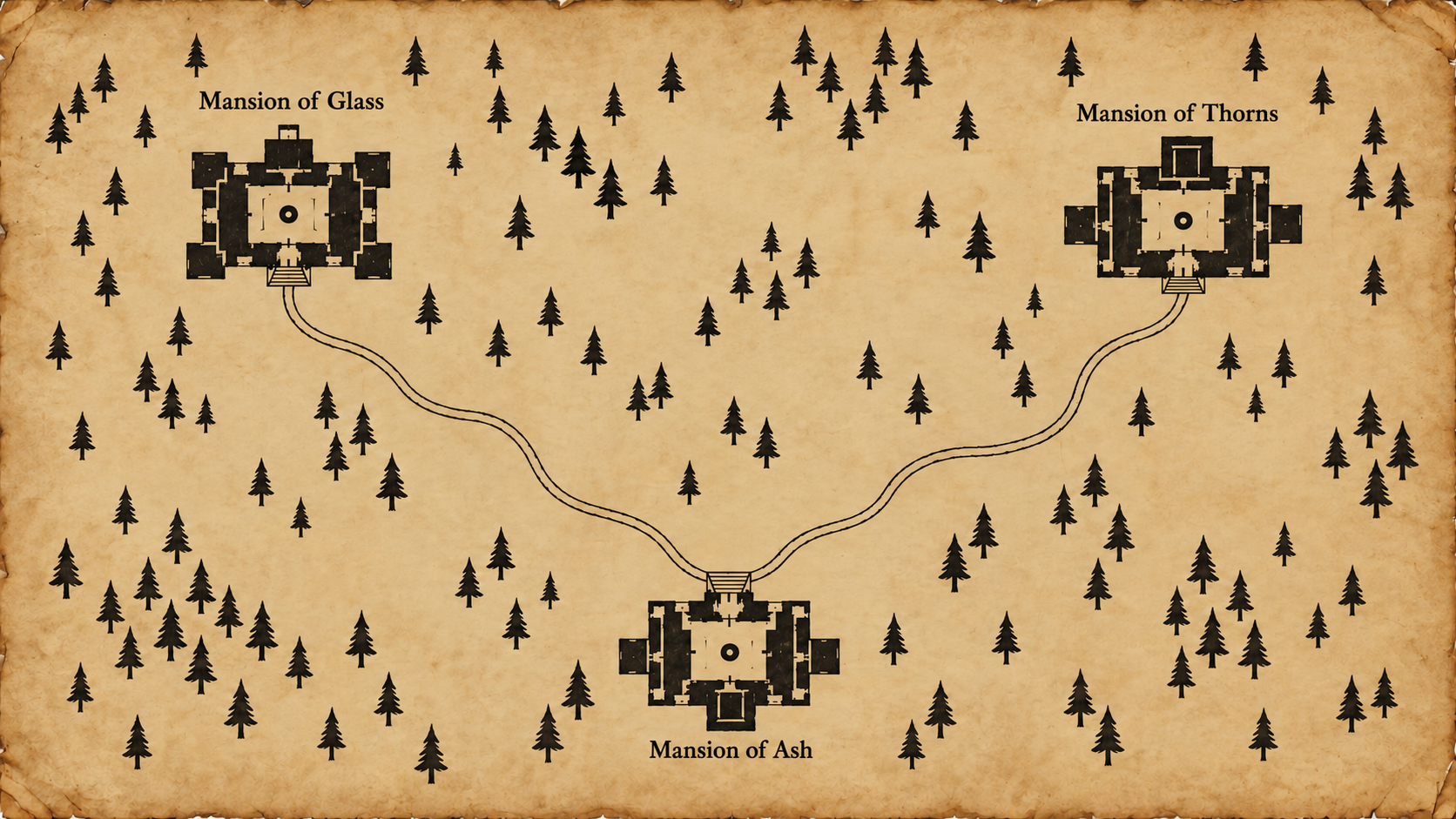
The Three Mansions
The Uskwood is not an untouched wilderness. Its trees have been guided for ages by hands that believe pain is a form of cultivation. Roads vanish beneath roots, moonlight gathers in the hollows, and every handsome house seems to have been built around a wound. The three mansions are not famous landmarks of Nidal. That is precisely why they are dangerous: they are a private design hidden inside a public nightmare.
Canon boundary: The Uskwood, Nidal, Zon-Kuthon, the Shades of the Uskwood, and the named locations below are Pathfinder canon. The Mansions of Ash, Glass, and Thorns, their owners, their linked mechanism, and the Ember Key are original to this adventure. They are placed in an unnamed tract of the Uskwood so they can coexist with published locations without replacing or contradicting them.
Placement in the campaign
This background sits at the module level, outside all three acts. It establishes the campaign’s shared history, canon boundary, and central mystery. Act 1 begins the playable sequence at the Mansion of Ash:
- S1 — Lower Level: Mansion of Ash: The flooded foundation, Twelvefold Alignment, submerged guardian, and Ash Lift establish the estate’s physical rule.
- S2 — Upper Level: Mansion of Ash: The soot gallery, active security system, and Ember Study turn that rule into a personal confrontation and reveal the sealed route onward.
After S2, the campaign continues to Act 2 — Mansion of Glass, then Act 3 — Mansion of Thorns. The three estates remain one linked circuit, but each act has its own lower-level and upper-level arc.
Canon frame: a forest cultivated into a nightmare
The Uskwood lies wholly within Nidal, surrounding the nation’s capital, Pangolais. It is an ancient hardwood forest, but it is not “wild” in the ordinary sense: generations of Zon-Kuthon’s followers have deliberately shaped it into a sinister garden. Its trees, paths, clearings, and predators express a theology of control. The forest does not need to be uniformly supernatural to feel hostile. It is enough that its natural processes have been trained toward dread.
That distinction is the key to running the Mansions. The estates are not a separate demiplane and they are not an unexplained gothic country dropped into Golarion. They are Nidalese architecture grown into an existing Kuthite landscape. Stone walls disappear into black roots. Water follows channels cut before the current owners were born. A hedge is beautiful because someone has taught it exactly where to turn its thorns.
Canon also gives the forest several kinds of neighboring truth. The Shades of the Uskwood are an albino druidic order devoted to Zon-Kuthon. Their initiation strips away pigmentation, their effigies crawl with the cold of the Midnight Lord’s hunting grounds, and they specialize in cold magic while being forbidden to evoke fire. The Uskheart is their center. The Sunless Pond is a supernatural spring gifted by Zon-Kuthon after Earthfall, whose dark water accelerates plant growth. The Lost Lodge is a forgotten Desnan safehouse protected by deathwebs. Summer Grove appears only in midsummer, while Shadowreach is avoided because shadow creatures hunt its environs. These places are not interchangeable set dressing; each offers a different answer to the question, “What does the Uskwood want?”
Why Zon-Kuthon matters here
Zon-Kuthon is the Midnight Lord, the Dark Prince, and the Prince of Pain. His canonical concerns include darkness, envy, loss, and pain. His edicts demand that followers bring pain into the world and mutilate their bodies; his anathema include creating lasting sources of light and offering comfort to those who suffer. In the Remastered presentation he may be sanctified as unholy, with ambition, darkness, destruction, and pain among his domains.
The oldest myths remember him as Dou-Bral, Shelyn’s half-brother. He left the world, was changed by what he encountered beyond ordinary reality, and returned as something cruel. The sibling wound is useful imagery, but it should not be treated as a license to make the Mansions a secret headquarters of Shelyn or a lost piece of divine history. The three houses imitate, distort, and exploit that myth; they do not rewrite it.
Likewise, the Mansions do not contain a piece of Zon-Kuthon’s body, a new god, or a hidden explanation for Nidal’s entire history. Their evil is smaller and more believable: a provincial estate cult attempting to make a local law of pain, memory, and inheritance. The cult’s blasphemy is not that it misunderstands Zon-Kuthon. It is that it believes it can improve on him.
The origin of the three estates
Before the current houses, the tract held a Kuthite hunting estate and a service road used by messengers traveling between the deeper forest and the settled routes near Pangolais. The original lodge was never important enough to receive a canonical name. Its foundations, however, sat above an underground watercourse that carried ash, iron-rich silt, and cold mineral water through the bedrock. The first builders used the stream to drain furnaces and ritual basins. Later owners discovered that the same channels could carry sound, reflected light, and marked objects from one house to another.
Three Nidalese households eventually divided the property. They were not members of the Black Triune, and they did not rule the nation. They were provincial custodians: useful, wealthy enough to be left alone, and careful to make their service look like piety. Each house took responsibility for a different stage of the same devotional practice.
Mansion of Ash
What it was meant to preserve: Loss made visible—the memory of the dead, the record of burned names, and the humility of rebuilding.
What it became: A house that stores grief as residue. Its flooded foundation and ash-water machinery turn memory into a physical burden.
Mansion of Glass
What it was meant to preserve: Envy and revelation—the desire to see what another possesses, hides, or might become.
What it became: A house that makes observation reciprocal. Its mirrors and windows do not merely show secrets; they teach the watcher that being seen is also a form of surrender.
Mansion of Thorns
What it was meant to preserve: Possession and inheritance—the belief that pain proves ownership and that leaving is a kind of betrayal.
What it became: A house that treats family, contract, and landscape as one binding organism. Its gardens grow around promises rather than paths.
The houses were designed as a circuit. Ash receives what is surrendered. Glass witnesses it. Thorns keeps it. A token from each estate was carried through the next, and the three tokens were joined during a rite called the Threefold Vigil. The rite was never a recognized Nidalese holiday. It was a private household observance, performed when an heir was appointed, a debt was forgiven, or a family member was ritually “returned” to the estate.
The hidden crime
The first custodians believed the forest could be made obedient by giving it a story. They told themselves that every loss could be contained in Ash, every secret clarified in Glass, and every attachment secured in Thorns. Their mistake was not merely moral. It was architectural. They built three houses that could not complete their work alone, then made each house dependent on the others’ failures.
Over generations, the Threefold Vigil changed. A memorial became an accounting. An accounting became a test. A test became a demand for proof. The houses began to require a living witness at the center of the circuit. Some witnesses were servants who volunteered under pressure. Some were heirs who believed endurance would spare their families. Some were travelers who were told that the road through the forest was closed until they paid a toll.
One generation tried to end the practice. The reformers hid the three estate tokens in separate parts of the Ash foundation, sealed the upper route, and destroyed the written sequence for the ritual machinery. They did not destroy the machine itself. That omission is why the current adventure begins below ground. The foundation has continued to run without a household capable of interpreting it. Water rises, ash marks move through the channels, and the mansion has begun to remember people who are no longer present.
The present crisis
The current disturbance is a local resurgence, not a new Age of Darkness. Something has caused the old circuit to wake: a surviving heir, a Kuthite antiquarian, a desperate servant, or a relic recovered from the wrong ruin can serve as the visible trigger. The GM can choose the culprit later. What matters at the table is that the mechanism is now trying to complete the Threefold Vigil with incomplete instructions.
In the Mansion of Ash, the flooded foundation is the first symptom. The Twelvefold Alignment is an emergency version of the old circuit: paired marks, counterweights, basins, and a submerged guardian all respond to the same missing sequence. The Ember Key is not a holy relic and does not represent a permanent light that defies Zon-Kuthon’s anathema. It is a household tool, a coal trapped in iron, designed to open the sealed stair to the ash-heart. Its danger comes from what it unlocks, not from secretly outclassing canon.
The Mansion of Glass will interpret the party’s arrival as a demand to be witnessed. It can replay the Ash estate’s memories, but it cannot tell which memories are true without a living observer to choose. The Mansion of Thorns will treat every promise made in the first two houses as a root seeking soil. If the party lies, the house may punish them; if they speak honestly, it may bind them more tightly. The houses are most frightening when their logic is consistent.
Factions and canon-safe connections
- The Shades of the Uskwood: They know the Mansions are an unhealthy graft on the forest, but they do not agree on whether to prune, study, or preserve them. Their cold magic and prohibition against fire make the Ember Key a politically dangerous object. A Shade may demand that the party extinguish it, or may quietly ask them to carry it where the order cannot be seen.
- The Whispered Song: Desnan resistance to Nidal’s shadow is a natural source of allies, especially because the Lost Lodge contains supplies, weapons, and relics of the Song of Spheres. The Lodge is canon; its connection to the Mansions is campaign-original. A hidden Desnan courier can know one route into the forest without knowing the truth of the three estates.
- The Guild of Liars: The canon House of Lies overlooks the Usk River and gathers storytellers and con artists. Its members are ideal keepers of a half-true genealogy. They may sell the party a name, a forged inheritance, or a story that opens one door while closing another.
- Castle of the Captive Sun: Volsazni Dezarr’s estate is renowned for artifacts and sacred marvels associated with light. The Castle is not one of the three Mansions. A collector, agent, or rival from that orbit may nevertheless want the Ember Key or the Glass estate’s records.
- Redcaps and shadow creatures: The Uskwood’s redcaps are free to roam and murder within their hidden lairs, while shadow creatures hunt around Shadowreach. Their presence should feel like the forest’s ambient danger, not proof that every monster serves the estate cult.
Adventure hooks
1. The fire that cannot be named
A Shade of the Uskwood finds a cold-forged lock-pin glowing with ember-light. The order wants it recovered before the forest’s younger growth begins to fail. The party must enter Ash, retrieve the Ember Key, and decide whether to return it, hide it, or use it.
2. A Desnan route gone silent
A courier bound for the Lost Lodge disappears after reporting three houses where no map should show any. The party is asked to recover the courier’s message, not rescue them. The message contains a route through the Mansions and a warning that one of the houses has learned to imitate a trusted voice.
3. The heir who inherited a debt
A frightened Nidalese heir offers the party legal title to one estate in exchange for ending the Threefold Vigil. The document is genuine, but accepting it makes the party responsible for every bound servant, buried promise, and unpaid ritual debt in the house.
4. The House of Lies remembers differently
A Guild of Liars storyteller claims the party’s names appear in an old estate ledger. They will reveal the missing page only if the party tells a story that is true, useful, and impossible to verify. The page identifies the first reformer who tried to shut down the Mansions.
5. A light desired by the Castle of the Captive Sun
An agent connected to Volsazni Dezarr offers protection and a generous reward for the Ember Key. The agent insists it is merely an artifact of historical interest. They are telling the truth about the reward and lying about the intended use.
6. Summer Grove’s brief mercy
During midsummer, a path to Summer Grove opens. The grove offers the party a rare place of beauty and calm, but the Shades of the Uskwood have never disrupted it. If the party brings Ash, Glass, or Thorn influence into the grove, the grove may close before they can leave.
Secrets for the GM
- The three houses were never a divine triad. Their owners invented the circuit to make their private authority feel inevitable.
- The submerged guardian in Ash is not the original victim of the rite. It is a maintenance intelligence made from accumulated fear, silt, and the last instructions of the reformers.
- Glass does not reveal an objective “true self.” It reveals the story the house expects the viewer to believe, then tests whether the viewer accepts that story.
- Thorns can be ended without burning the forest. The correct resolution is to separate ownership from obligation and give the estate’s bound names somewhere else to belong.
- The Shades of the Uskwood are not a single-minded ally or enemy. Their loyalty is to Zon-Kuthon, the forest, and their own order, in that order only when circumstances force a choice.
Running the canon
Keep the Uskwood specific. Mention the gray hardwood, blue-gray fog, cold that arrives without weather, and the way darkness seems to gather rather than merely block sight. Let canonical locations remain meaningful offstage: the party should hear that Uskheart is watched, that the Lost Lodge is real, that Summer Grove has a season, and that Pangolais is not simply a generic evil city. Do not present the Mansions as the source of Nidal’s darkness. They are one carefully hidden expression of it.
For the faith of Zon-Kuthon, emphasize law, envy, loss, and pain rather than random cruelty. The estates are terrifying because their rites have rules. The best counterpoint is not a lecture about goodness; it is a character choosing to offer comfort, preserve a name, open a path, or leave something beautiful unowned.