Write a message

Reiver's Right — E18-11

The Blightroot

A rooted infestation at the end of the excavation.

Beyond the drilling floor, the passage ends against a wall buried beneath black roots. They radiate from a dense knot of swollen wood lodged in the far recess. Sap runs through cracks in its bark, and ember-red light pulses deep inside.

Older shoring timbers stand half-swallowed by the growth. Feeder roots follow drainage cuts and fractures in the stone, reaching back toward the galleries behind you.

Two small tangles of hooked roots uncurl beside the central mass. A thicker tendril lifts from the floor, dragging grit across the stone.

The Rooted Organism

Full roster — 7 creatures: 1 Blightroot (Creature 2); 2 Infernal Rootlings (Creature 0 each); 1 Infernal Thornling (Creature 1); 2 Orts (Creature 0 each); and 1 Imp (Creature 1). These are the monsters currently attached to E11; none are optional in this roster. Run the action across E18-10 and E18-11 as one connected encounter.

The Blightroot is biologically a stationary infestation and mechanically a creature. Use its linked monster block: AC 17, HP 50, Speed 0, fire resistance 3, vitality weakness 5. Attacks damage its central mass. There is no separate four-node puzzle or complex-hazard routine.

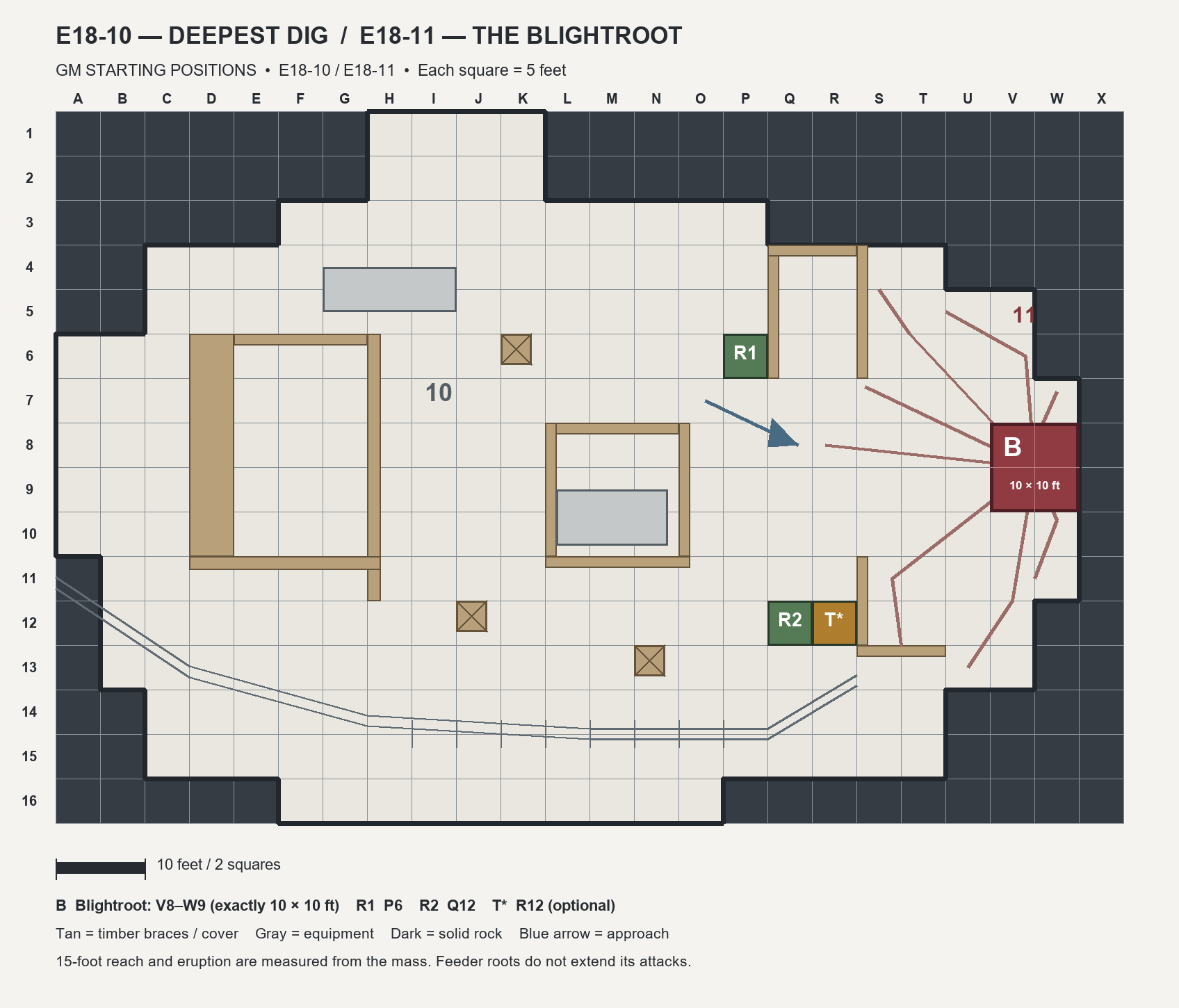
Starting the fight: Roll initiative when the party enters E18-10 and the defenders spring their coordinated attack. The Infernal Rootlings and Thornling advance out of E18-11 and attack from the recess, while the two Orts attack from the south. The Blightroot remains fixed in E18-11, acting only against targets within its actual reach, range, and line of effect. The imp initially stays at the alchemical stations destroying documents; it does not attack unless attacked first. Each creature acts on its own initiative.

Placement & Tactics

Place the Large central mass in a 10-foot-by-10-foot space against the far wall at map marker 11. Measure its 15-foot reach and eruption emanation from that space. Place the two rootlings along the approach-side edges of E18-11 and the thornling by the nearer root-covered brace. Position the two Orts to attack from the south side of E18-10; place the Imp at the E18-10 alchemical stations destroying documents. Use the stone and timber shown on the map for positioning rather than adding a second set of platforms or water channels inside the recess.

When several intruders close, the Blightroot uses Grasping Root Eruption for two actions, followed by a root lash if a target is reachable. Against one close target, it can use Hellroot Surge and lash twice, applying the normal multiple attack penalty. It uses caustic sap against visible targets farther away and Black Sap Spray with its available reaction when triggered.

Rootlings and Thornling: When the party steps into E18-10, these mobile defenders charge or fire from E18-11 into the drilling floor. Rootlings use their single-square Hellroot Eruption, ranged thorns, and agile talons; Thornlings use their reach and Bramble Burst. They pursue and fight to the death, even if the Blightroot is destroyed. The Blightroot's eruption affects allies in its area normally.

Orts: Attack the party from the south side of E18-10 at the same trigger. Use their individual creature blocks and normal movement/line-of-effect rules. They fight to the death.

Imp: Begin at the alchemical stations in E18-10, actively tearing, burning, or otherwise destroying documents instead of joining combat. The imp remains nonaggressive unless a character attacks it. Once attacked, it uses invisibility to reposition and strike at vulnerable back-line characters, prioritizing spellcasters, ranged combatants, and isolated targets. It is the sole retreating enemy: when its current HP falls below 40% of its maximum, it abandons the fight and attempts to escape using invisibility. Other defenders fight to the death.

The Blightroot cannot move (Speed 0). Its feeder roots are not remote attack origins; it cannot attack through solid walls or blocked line of effect into E18-10 — Deepest Dig. It uses its ranged and reach attacks only when a valid target is exposed. Unlike the stationary mass, the Rootlings and Thornlings may cross into E18-10 and pursue the party. All enemies except the imp fight to the death.

Investigation: What Grew Here?

During combat use the monster block's Nature or Religion DC 18 Recall Knowledge to reveal useful defenses or abilities. The following physical examinations are easiest after the fight.

  • Nature or Survival DC 16 — Trace the Roots: Growth radiates outward from this mass. A critical success identifies older central tissue and younger feeder roots.
  • Crafting or Nature DC 17 — Study the Sap: Altered plant tissue carries an unnatural mineral component. A critical success reveals tiny gold-colored crystalline deposits.
  • Crafting or appropriate Lore DC 16 — Compare the Work: The excavation, shoring, and drainage cuts predate the growth. A critical success shows how those cuts gave the roots paths outward through the rock.

Together, these clues support a concentrated growth established after the chamber was excavated. They do not identify who planted a seedling, how Hendrick acquired his fragment, or what the old structure in E18-10 contains.

Quest Item · Fresh Tissue

Defeating the central mass stops its attacks and releases creatures immobilized by its eruption. The other defenders remain active if the Blightroot is destroyed; they do not automatically die with it. The Imp may retreat under its separate tactics.

Once the area is safe, recover the Fresh Blightroot Sample with Crafting, Medicine, or Nature DC 16. A failure spoils one small cutting; another attempt can be made after 10 minutes of careful work. Pack viable inner tissue in waxed cloth or sealed glass.

This is the fresh research material Morwenna needs for a stabilized neutralizer. It is not itself a cure. Defeating the organism ends this active local concentration, not every infestation in the Palakar.

The End of This Route

Solid stone lies behind the root mass. Removing it reveals no hidden passage or surface exit. The party returns through E18-10 with its sample and evidence; investigation of the buried construction belongs to the larger Golden Hand and Pulgari arc.

Blightroot — no preview content.